






TL;DR: AI crawlers don’t read websites the same way traditional search engine crawlers do. They extract structured information, relationships, context, and authority to generate AI-powered answers. While high-quality content is essential, website speed still matters because faster websites are easier to crawl, render, process, and revisit. Optimizing your site’s performance improves accessibility for both AI search crawlers and human visitors.
Search is changing rapidly. Instead of simply showing a list of links, platforms like ChatGPT, Google AI Overviews, Perplexity, Claude, and other AI assistants increasingly generate direct answers by analyzing information from across the web. That shift has led many website owners to ask an important question:
How do AI crawlers read websites, and does website speed still matter?
The short answer is yes.
Although AI web crawlers are much better at understanding language than traditional search bots, they still rely on being able to efficiently access, crawl, render, and understand your pages. A slow website creates unnecessary friction, not only for users but also for AI systems trying to interpret your content.
In this guide, you’ll learn how AI crawlers work, how they process websites differently from traditional search engines, and why optimizing website speed for AI crawlers should be part of every modern SEO strategy.
How AI Reads and Interprets Your Website
AI crawlers go beyond keywords to understand your website’s structure, context, and credibility. Here’s a quick look at the key signals they analyze before interpreting your content.
| How AI Crawlers Read Websites | What It Means |
|---|---|
| They crawl the HTML first | AI crawlers scan your HTML, headings, links, images, and metadata to access content. |
| They identify content structure | Clear headings and semantic HTML help AI understand your page better. |
| They understand entities and relationships | AI focuses on topics, context, and connections, not just keywords. |
| They evaluate trust signals | Original content, credible sources, and E-E-A-T help establish trust. |
| Website speed supports AI crawling | Faster pages are easier to crawl, render, and process efficiently. |
What Are AI Crawlers?
AI crawlers are automated bots that discover, access, and analyze web pages so AI models can understand information across the internet.
Unlike traditional search crawlers, which primarily discover and index webpages for search engines, AI crawlers place greater emphasis on understanding the meaning and context behind the content they access. They look at signals such as:
- The topic of a page
- Relationships between concepts
- Context behind information
- Author expertise
- Content freshness
- Website trust signals
These insights help AI assistants generate accurate responses instead of simply returning search results.
Examples include crawlers used by AI-powered search platforms and large language model providers. While each platform collects and processes web content differently, they all rely on being able to access and understand publicly available information.
Now that you know what AI crawlers are, let’s look at how they actually read and interpret your website.
How AI Crawlers Read Websites
Understanding how AI crawlers read websites requires looking beyond traditional indexing. Rather than treating a webpage as a collection of keywords, AI systems attempt to understand its meaning, much like a human reader would.

1. They Crawl the HTML First
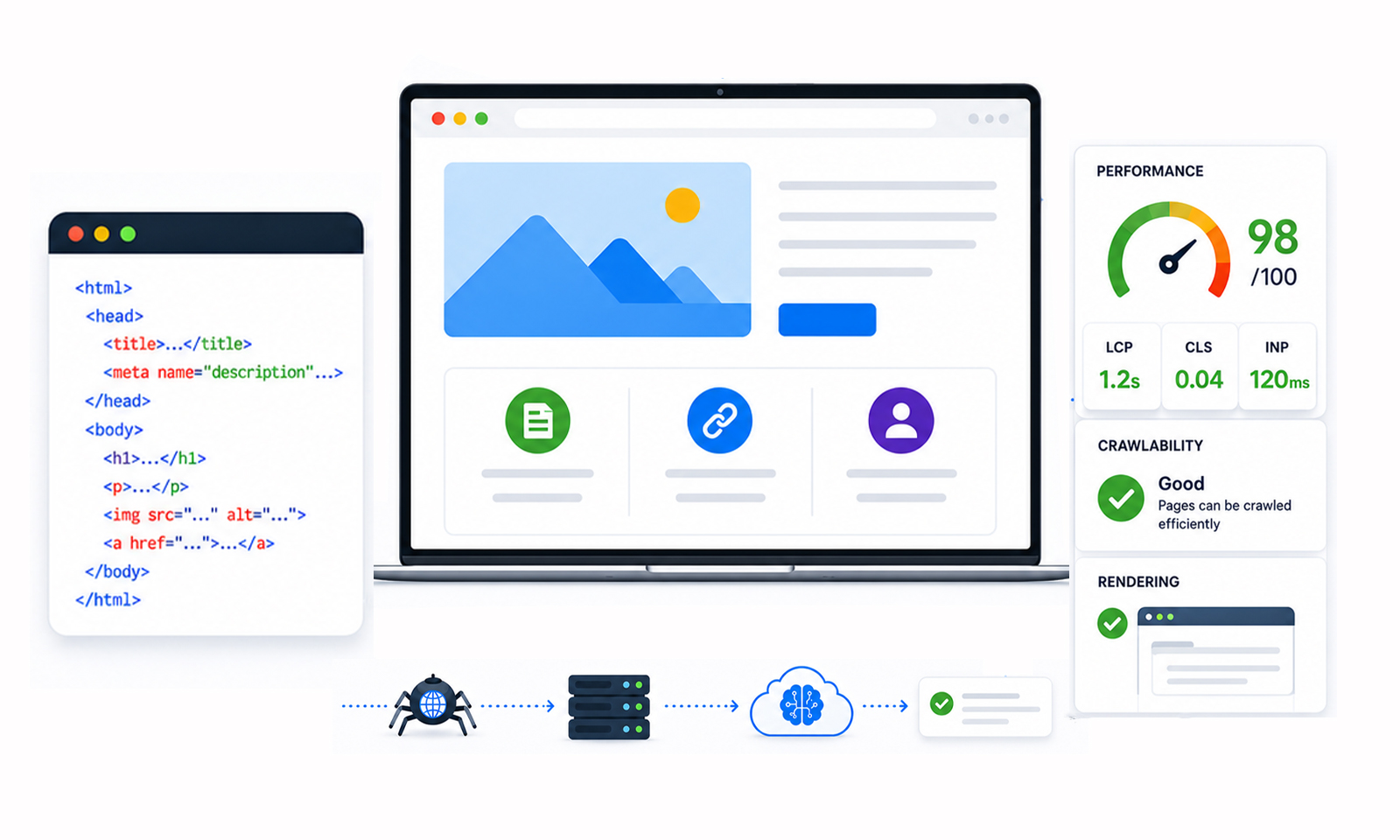
Like traditional search bots, AI bots first request your webpage and analyze the HTML. They examine elements such as
- Titles
- Headings
- Paragraphs
- Links
- Images
- Metadata
- Structured data
If important content only appears after complex JavaScript execution, some AI bots may not interpret it as effectively. This is one reason server-side rendering and accessible HTML remain important.
2. They Identify Content Structure
AI website crawling relies heavily on logical organization. Clear heading hierarchy (H1-H4), concise paragraphs, descriptive headings, and semantic HTML help AI understand where one idea ends and another begins.
Well-structured content is easier for AI systems to summarize accurately.
3. They Understand Entities and Relationships
Modern AI models don’t just look for repeated keywords. Instead, they identify entities and relationships such as
- Companies
- Products
- Technologies
- Locations
- People
- Concepts
For example, an article about Core Web Vitals naturally connects concepts like LCP, CLS, and INP, user experience, and website performance. The richer those relationships are, the easier it becomes for AI to understand your expertise.
4. They Evaluate Trust Signals
AI systems also evaluate signals that help them determine whether content appears reliable and trustworthy.
These include:
- Original research
- Citations from authoritative sources
- Updated information
- Consistent topical coverage
- Author expertise
- Technical accuracy
Google’s guidance around helpful content and E-E-A-T remains highly relevant because trustworthy content is valuable for both traditional search and AI-generated answers.
AI Crawlers vs Traditional Search Crawlers
While both crawl websites, AI bots focus on understanding meaning and context rather than simply indexing pages for search results. Here’s how their approach differs.
| Traditional Search Crawlers | AI Crawlers |
|---|---|
| Focus on indexing pages | Focus on understanding content |
| Match keywords | Understand meaning and intent |
| Rank documents | Generate answers |
| Evaluate links heavily | Evaluate context, authority, and relationships |
| Retrieve pages | Build knowledge from multiple sources |
Instead, AI has expanded what good optimization looks like. To optimize websites for AI, your content needs to be technically accessible, semantically clear, and genuinely useful.
Why Website Speed Still Matters for AI Crawlers
Some website owners assume AI only cares about content quality. In reality, website speed for AI crawlers still plays an important role.
Faster Crawling
When pages respond quickly, crawlers can process more URLs within their crawl budget.
While crawl budget primarily affects larger websites, reducing server response times benefits all types of crawlers. Google explains crawl efficiency in its documentation.
Better Rendering
Many websites rely on JavaScript. If rendering becomes slow or resource-intensive, AI bots may have a harder time accessing important content.
Reducing unnecessary JavaScript, eliminating render-blocking resources, and improving server response times all help make pages easier to interpret.
Improved Content Accessibility
AI crawlers work best when important information appears quickly in the HTML. If your primary content loads immediately instead of depending on delayed scripts, AI systems can understand your page more reliably.
Better User Signals
AI search experiences increasingly prioritize content that satisfies users. Website speed directly affects:
- Bounce rate
- Engagement
- Time on page
- Conversion rates
- Overall user experience
Tenet’s research has shown that when mobile page load time increases from one second to three seconds, the probability of a bounce rises by 32%.
Similarly, one other study says that 53% of mobile users abandon sites that take over 3 seconds to load.
It’s important to note that website speed isn’t currently known to be a direct ranking factor for AI-generated answers. However, faster websites improve crawl efficiency, rendering, accessibility, and user experience, making it easier for AI systems to discover and understand your content.
How to Optimize Your Website for AI Crawlers
To optimize your website for AI crawlers, create high-quality content, organize it with clear headings, implement structured data, improve Core Web Vitals, reduce unnecessary JavaScript, optimize images, strengthen internal linking, and keep your content updated.
Publish High-Quality Content
Create original content that directly answers user questions with practical insights, real-world examples, and expert knowledge.
Use Clear Structure
Organize content with descriptive headings and semantic HTML so AI crawlers can easily understand your page.
Add Structured Data
Add relevant schema markup, such as Article, FAQ, or Product schema, to provide additional context about your content. Structured data makes it easier for AI systems and search engines to interpret important information.
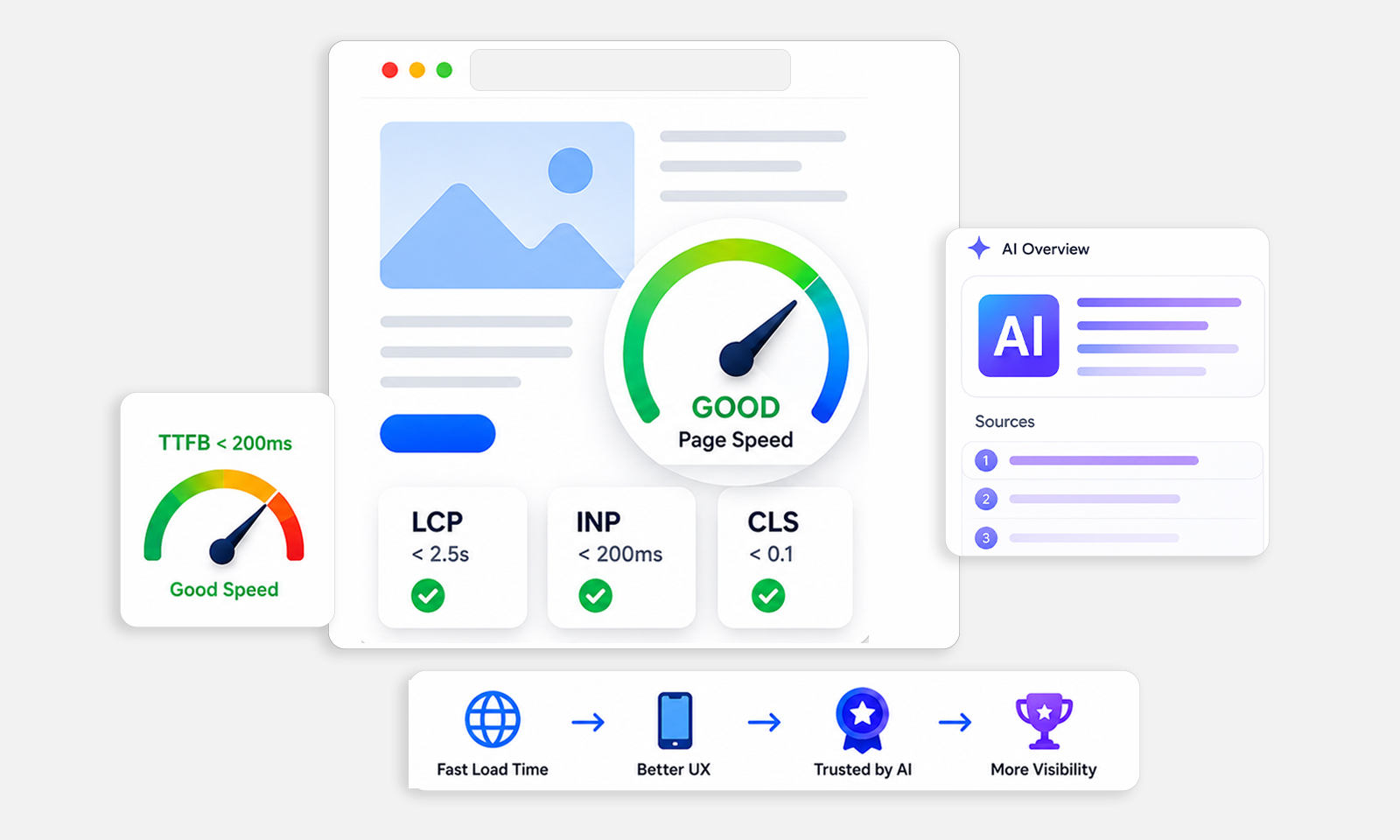
Improve Core Web Vitals
Optimize metrics like Largest Contentful Paint (LCP), Interaction to Next Paint (INP), and Cumulative Layout Shift (CLS). Better Core Web Vitals improve user experience while making your website more efficient for AI website crawling.
Reduce Unnecessary JavaScript
Heavy JavaScript can delay rendering and make important content harder for some AI bots to process. Removing unused scripts and reducing JavaScript execution time helps ensure your content is accessible quickly.
Optimize Images
Compress images and use formats like WebP or AVIF to reduce page weight without sacrificing quality. Faster-loading pages improve website speed for AI crawlers and create a better experience for visitors.
Strengthen Internal Linking
Connect related articles using descriptive anchor text to help AI crawlers understand relationships between topics. A strong internal linking structure also improves content discovery and topical authority.
Keep Content Updated
Review and refresh your content regularly to keep it accurate, relevant, and complete. Up-to-date content is more useful for both users and AI systems because it reflects current information and evolving best practices.
Why Website Speed Supports AI Search Visibility
Website speed has evolved beyond ranking factors.
Today, it affects:
- human visitors
- traditional search engines
- AI search crawlers
- AI-generated search experiences
- website accessibility
- crawl efficiency
- content discoverability
As AI becomes a larger part of search, fast websites gain an additional advantage, as they make it easier for intelligent systems to understand and reuse information.
That’s why performance optimization should be viewed as part of an AI-ready website strategy rather than only a traditional SEO task.
Conclusion
Understanding how AI crawlers read websites is becoming essential as AI-powered search continues to evolve. While these systems are far better at interpreting language and context than traditional crawlers, they still depend on technically accessible, well-structured, and fast-loading websites.
If your goal is to make your website more visible in AI-powered search experiences, don’t treat website speed and content quality as separate priorities. The strongest AI-ready websites combine authoritative information with excellent technical performance. As AI-powered search continues to evolve, websites that balance trustworthy content with fast, accessible performance will be best positioned to remain discoverable, regardless of how people search.
Frequently Asked Questions
1. How do AI crawlers read websites?
2. Are AI crawlers different from Googlebot?
3. Does website speed affect AI crawlers?
4. How can I optimize my website for AI?
5. Can AI bots crawl JavaScript websites?
6. Will AI replace traditional SEO?
About the Author