






TL;DR: One approach gets content on screen almost instantly but needs extra work behind the scenes, while the other delays what users see at first but delivers a smoother, app-like experience after load. The right choice depends on whether the speed of visibility or interaction matters more.
Every millisecond counts on the web. A one-second delay in page load time can drop conversions by up to 7%, and Google’s ranking algorithms are increasingly rewarding sites that perform well across Core Web Vitals. And the biggest lever most teams are either pulling wrong or not thinking about at all, server-side rendering vs client-side rendering. Which approach actually delivers a faster experience? And more importantly, which one is right for a given project?
SSR vs CSR: Quick Answer
- SSR is faster for initial page load (better FCP & LCP)
- CSR is faster after load (better navigation & interaction)
- SSR is better for SEO
- CSR is better for highly interactive apps
What Is Server-Side Rendering (SSR)?
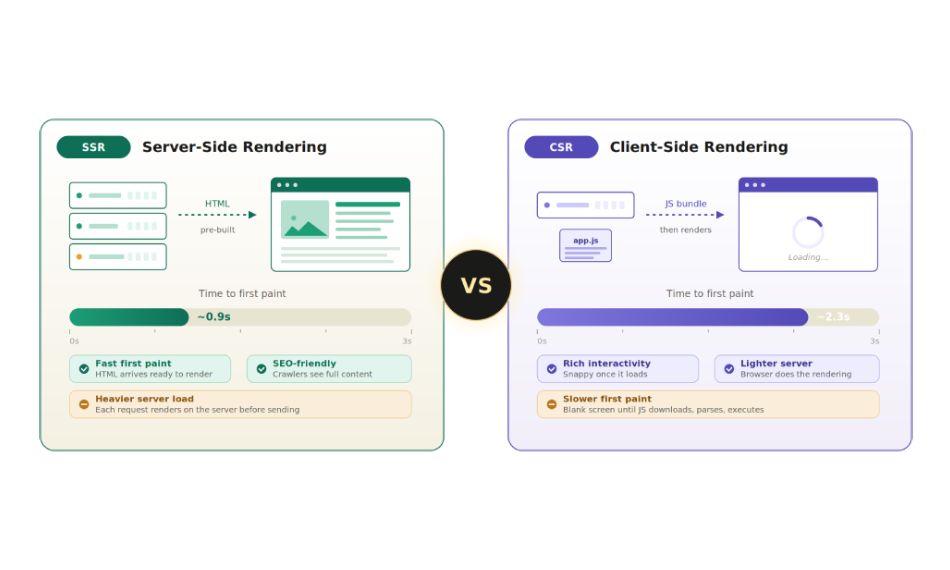
Server-side rendering is the process of generating a complete HTML page on the server before sending it to the browser. When a user makes a request, the server processes that request, fetches the necessary data, builds the full HTML document, and delivers it ready to display. The browser receives a fully-formed page almost immediately.
Frameworks like Next.js, Nuxt.js, and SvelteKit bring SSR into the component-based, JavaScript-driven world of today’s development ecosystem.
How SSR Works Step by Step
- The browser sends a request to the server.
- The server fetches data from a database or API.
- The server renders the complete HTML page using that data.
- The browser receives ready-to-display HTML and renders it almost instantly.
- JavaScript then “hydrates” the page, attaching event listeners to make it fully interactive.
That hydration step is worth remembering. It’s the phase where SSR applications can sometimes stumble, but more on that shortly.
What Is Client-Side Rendering (CSR)?
Client-side rendering flips the model. The server sends a minimal HTML shell, often little more than a <div id="root"></div> and a link to a JavaScript bundle. The browser downloads that JavaScript, executes it, fetches the required data, and then builds the page entirely on the client’s device.
React (without SSR), Angular, and Vue.js applications running as Single Page Applications (SPAs) are the most common examples. The experience, once loaded, feels smooth and app-like. Navigation between pages happens instantly because only data changes, not the entire HTML document.
How CSR Works Step by Step
- The browser requests a page from the server.
- The server responds with a minimal HTML file and a JavaScript bundle.
- The browser downloads and parses the JavaScript.
- JavaScript fetches data from APIs.
- The DOM is constructed, and the page becomes visible and interactive.
The important thing to understand here is that steps 3 through 5 all occur before the user sees anything meaningful. On slow networks or low-powered devices, that blank-screen period can be brutal.
SSR vs CSR: Key Performance Differences Explained
This is where the SSR vs CSR debate becomes more nuanced. Different performance metrics often favor different rendering strategies, which is why both approaches continue to exist in modern web development.
First Contentful Paint (FCP) and Largest Contentful Paint (LCP)
SSR has a clear advantage in FCP and LCP. Because the server delivers fully rendered HTML, the browser can paint meaningful content on screen almost immediately after the network response arrives. There’s no waiting for JavaScript to download, parse, and execute before anything shows up.
CSR applications, on the other hand, often show a blank white screen or a loading spinner during that initial JavaScript processing phase. For LCP specifically, which measures when the largest visible content element renders, CSR applications can struggle significantly. Audits of CSR applications have consistently found LCP times falling in the 4-5 second range when not carefully optimized, which is well outside Google’s recommended threshold of 2.5 seconds.
Switching from client-rendered pages to server-rendered ones dropped initial render times from approximately 2.4 seconds to 0.8 seconds, a 67% improvement.
Time to First Byte (TTFB)
Here’s the twist that surprises many developers: CSR often wins on TTFB. Since the server is only sending a lightweight HTML shell without any processing or data fetching, the first byte arrives quickly, sometimes under 50ms. SSR servers, by contrast, need to fetch data, process it, and build the HTML before they can send anything back. That can push TTFB into the 200ms-800ms range depending on server load and query complexity.
But this metric can be misleading. A fast TTFB in CSR is immediately followed by a long stretch of silence while the JavaScript bundle downloads and executes. So while the server responds quickly, the user still waits.
Time to Interactive (TTI)
TTI measures when a page is not just visually loaded, but actually interactive, when clicks and inputs work as expected.
After the server delivers the HTML and the page is visible, JavaScript still needs to “hydrate” it. During hydration, the page looks functional but isn’t. Clicking buttons may not work. Submitting forms can fail silently. This window, sometimes called the “uncanny valley” of web performance, is one of SSR’s most significant weaknesses. If hydration takes more than 2 seconds, users will interact with elements that don’t respond, leading to frustration.
CSR, once the JavaScript bundle is fully loaded and executed, becomes interactive without a separate hydration phase. But the total time to reach that state is typically much longer.
How SSR and CSR Affect Core Web Vitals
Google’s Core Web Vitals are the three performance signals that most directly influence search rankings today: Largest Contentful Paint (LCP), Interaction to Next Paint (INP), and Cumulative Layout Shift (CLS). The rendering approach chosen has a direct and measurable effect on all three.
Largest Contentful Paint (LCP)
SSR is strongly advantageous here. Content is delivered in the initial HTML payload, so LCP elements load without waiting for JavaScript. Google recommends LCP under 2.5 seconds. SSR applications, when paired with proper caching, routinely hit this target.
CSR applications often miss it without aggressive optimization like code splitting, lazy loading, and CDN-served assets.
Interaction to Next Paint (INP)
INP replaced First Input Delay (FID) as a Core Web Vital in 2024. It measures the latency of all user interactions, not just the first one. Here, the picture is more nuanced. SSR applications can suffer during the hydration phase when the main thread is blocked by JavaScript execution, causing sluggish responses to clicks or keystrokes. CSR applications, when code-split effectively, can achieve excellent INP scores because they control precisely when JavaScript executes. The target is under 200 milliseconds.
Cumulative Layout Shift (CLS)
CLS measures visual stability, how much the page layout shifts unexpectedly as assets load. SSR typically performs better here, too, because the complete page structure is sent upfront. CSR applications frequently experience layout shifts as JavaScript populates empty containers with dynamic content, which can annoy users and hurt rankings.
How SSR and CSR Perform on Mobile Devices
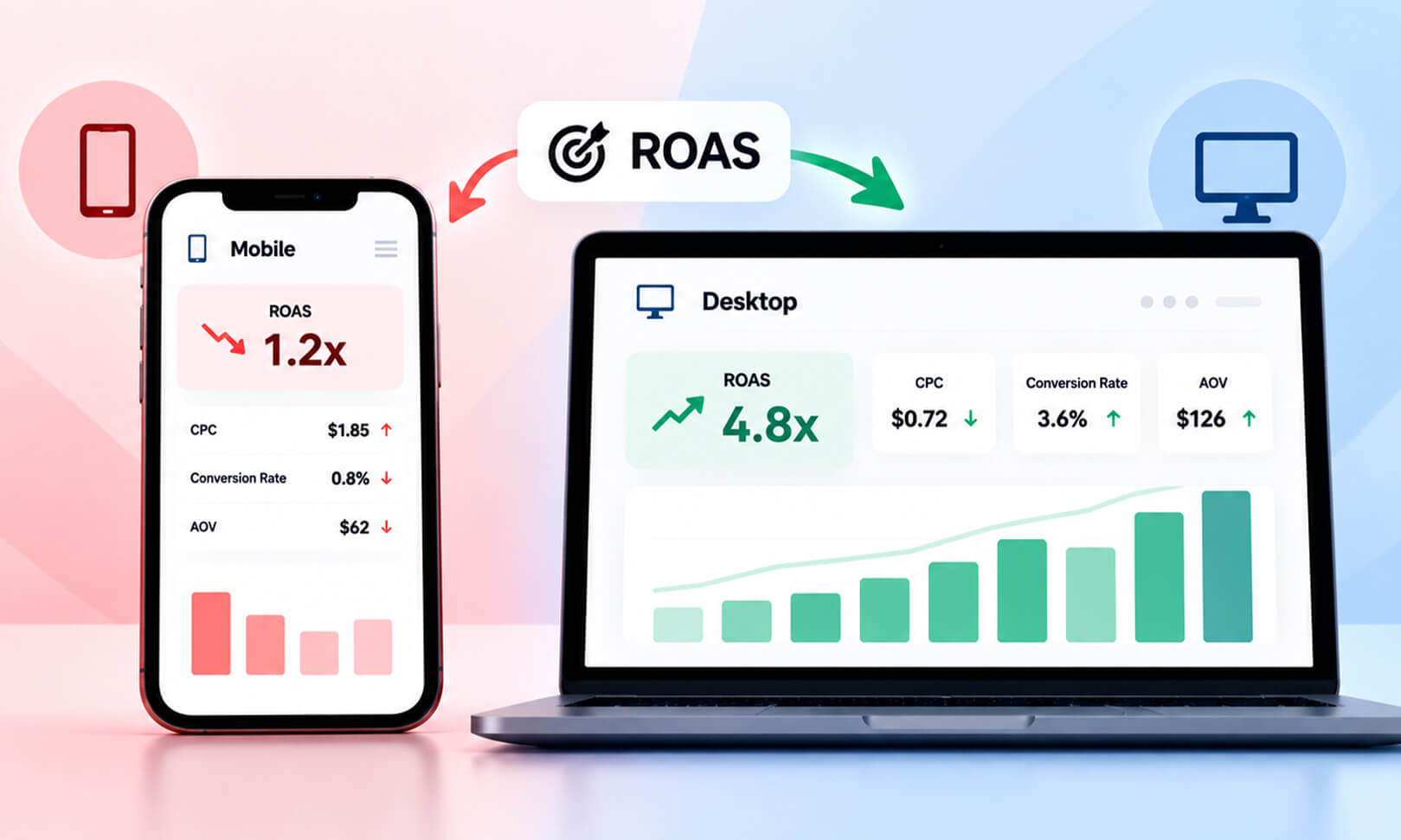
Mobile devices are where the differences between SSR and CSR start becoming much harder to ignore. On a high-end desktop with a fast connection, users may barely notice the rendering strategy behind a site. But on slower networks or lower-powered phones, the cost of JavaScript becomes much harder to hide.
CSR applications often need to download, parse, and execute large JavaScript bundles before meaningful content appears on screen. That delay can significantly hurt perceived performance, especially on budget Android devices where CPU limitations become the factor rather than the network itself.
SSR reduces that problem by sending pre-rendered HTML immediately. Content becomes visible earlier, which improves perceived speed and usually leads to stronger mobile LCP scores. Since Google evaluates most websites using mobile-first indexing, those performance differences can directly influence both rankings and user engagement.
That doesn’t mean CSR cannot perform well on mobile. Modern CSR applications can still achieve excellent results with aggressive code splitting, lazy loading, caching, and optimized asset delivery. But without that level of optimization, mobile devices tend to expose the weaknesses of client-side rendering much faster than desktop environments do.
Which Rendering Approach Is Better for SEO?
This is one of the most frequently asked questions in the SSR vs CSR debate, and the answer has become more complex than it used to be.
Googlebot has improved its ability to render JavaScript over the years. It can now index CSR content, but not as reliably or as quickly. JavaScript-rendered pages enter a “two-wave” indexing process: Google first crawls the raw HTML, then comes back later to render the JavaScript. That second crawl can take days or even weeks. During that delay, newly published content may not appear in search results.
SSR eliminates this entirely. Search engines receive the complete, fully rendered HTML on the very first request. Content gets indexed immediately, structured data within rich snippets is parsed correctly, and there’s no dependency on Google’s JavaScript rendering queue.
For content-heavy sites like blogs, news publications, product pages, landing pages, SSR provides a meaningful, compounding SEO advantage. The structured data that powers rich snippets in search results is also far more reliable when embedded in server-rendered HTML rather than injected by JavaScript after the fact.
SSR vs CSR Use Cases: When to Use Each
The Hybrid Approach: Getting the Best of Both
Modern frameworks like Next.js and Nuxt.js make it possible to render different pages or even different components using different strategies.
A Next.js application might server-render the home page and all product pages for maximum SEO and LCP performance, while using client-side rendering for the shopping cart, user account pages, and interactive product configurators. This per-route, per-component flexibility is what makes the hybrid model so powerful.
React Server Components allow components that handle data fetching and static output to run exclusively on the server, sending zero JavaScript to the client for those parts while interactive components remain client-rendered. This approach delivers a 70% reduction in TTFB and 40% lower server costs in production e-commerce deployments.
When to Use Server-Side Rendering (SSR)
SSR makes the most sense when one or more of the following conditions apply:
The application is content-heavy and depends on organic search traffic. Initial page load performance is critical, particularly on mobile or slow networks. The site needs rich snippet support through structured data. The target audience may be using budget Android devices or slower connections. Product pages, blog posts, or any publicly accessible content need to be indexed quickly and reliably.
When to Use Client-Side Rendering (CSR)
CSR remains the right choice in specific situations. Applications that live behind authentication walls, such as dashboards, admin panels, and internal tools, don’t need to be crawled by search engines. There’s little reason to pay the server-rendering overhead for pages that Google will never index. Similarly, applications that require highly dynamic, real-time behavior, like collaborative tools, interactive data visualizations, and financial platforms, often perform better when the entire rendering logic lives on the client. Once the initial JavaScript loads, navigation and state updates become nearly instantaneous.
Is SSR Always the Best Choice for Performance?
Not automatically. While SSR wins on perceived initial load performance, it introduces its own costs. Every server-rendered request consumes server CPU and memory. Under high traffic, this can become expensive and difficult to scale without thoughtful caching strategies. Hydration overhead, the time spent re-attaching JavaScript to the already-rendered HTML, can create a period of non-interactivity that hurts INP scores if not carefully managed.
The honest answer is that SSR wins the speed perception battle, users see content faster, while CSR wins the interaction fluidity battle after initial load. Neither is universally superior. The right answer is always context-dependent.
Final Verdict: SSR vs CSR
The server-side rendering vs client-side rendering decision is a spectrum. SSR delivers faster perceived loads, stronger SEO, better Core Web Vitals scores for LCP and CLS, and more reliable rich snippet indexing. CSR delivers smoother post-load interactivity, simpler scaling, and lower server costs for applications that don’t need public search visibility.
Frequently Asked Questions
Q1: Is server-side rendering faster than client-side rendering?
Q2: Which is better for SEO: SSR or CSR?
Q3: How does SSR affect Core Web Vitals?
Q4: When should server-side rendering vs client-side rendering be used?
Q5: Is SSR always the best choice for performance?
About the Author