






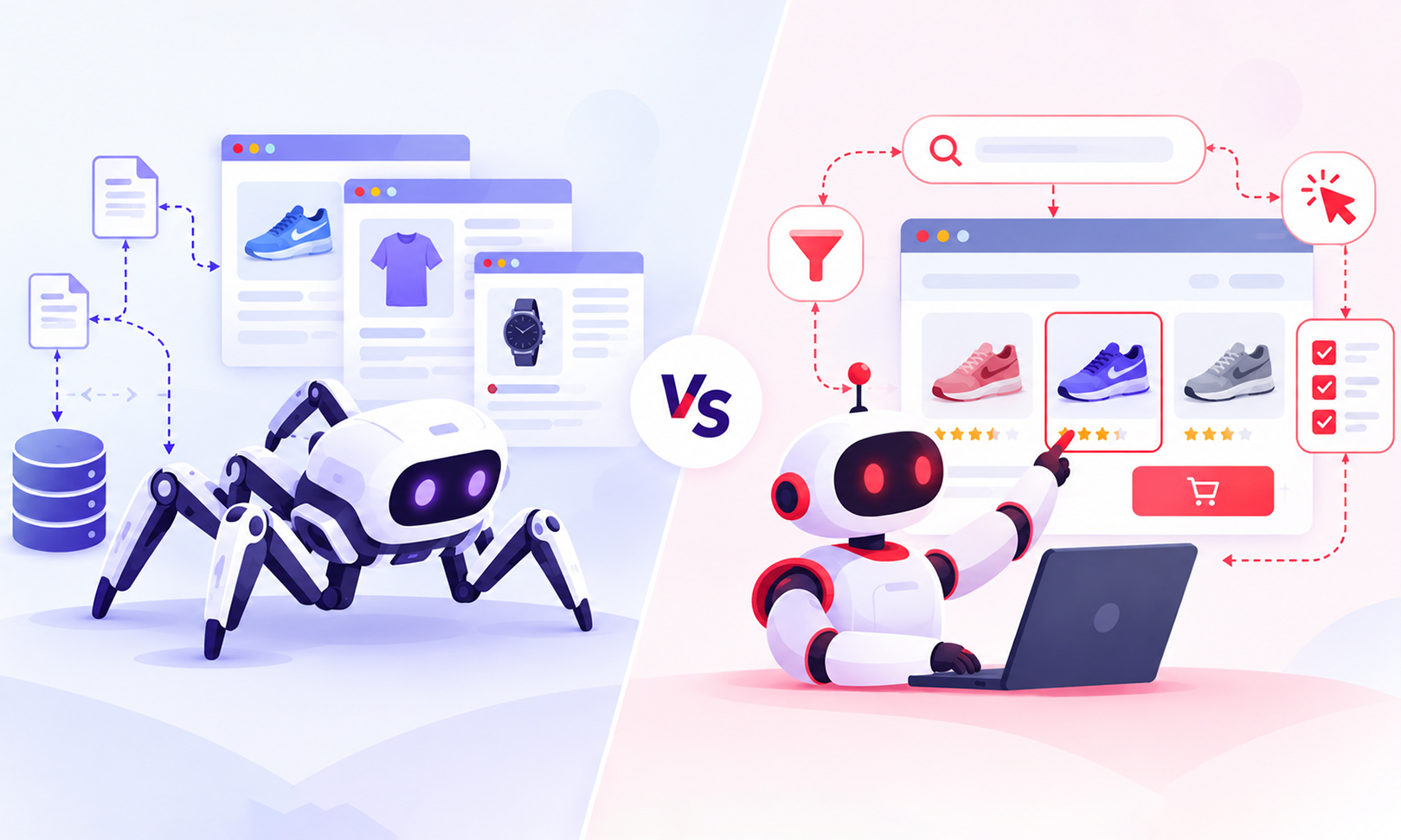
TL;DR: AI crawling primarily discovers, fetches, and processes web content. Agentic browsing uses an AI agent to navigate and interact with web pages based on a goal, such as comparing products, filling out a form, or completing a workflow.
AI systems can access the web in more than one way. Some systems crawl pages to discover and process information, while newer AI agents can navigate websites and interact with them much like a user would. That is the key distinction between agentic browsing and AI crawling.
Although both involve AI systems accessing websites, they are not the same process. An AI crawler is generally focused on finding and processing information. An agentic browser is focused on using the web to accomplish a goal.
Understanding that difference is becoming more important as AI search and autonomous AI agents become more capable of working with websites.
Quick Overview: Agentic Browsing vs AI Crawling
AI crawling focuses on discovering and processing web content, while agentic browsing focuses on navigating websites and completing tasks. The table below highlights the key differences.
| Difference | AI Crawling | Agentic Browsing |
|---|---|---|
| Purpose | Discover and process information | Complete tasks on the web |
| Behavior | Fetches and analyzes pages | Navigates and interacts with pages |
| Decision-making | Primarily retrieval-focused | Makes decisions based on goals and page state |
| Interaction | Usually limited | Can click, type, select, and submit |
| Output | Information or processed data | Answer, decision, or completed action |
In simple terms: AI crawlers are designed to understand web content, agentic browsers are designed to use the web.
What Is AI Crawling?
AI crawling generally refers to automated systems discovering, fetching, and processing web content so it can be analyzed, indexed, retrieved, or otherwise used by an AI or search system.
The basic concept is similar to traditional web crawlers used by search engines. A crawler can start with URLs, request pages, extract information, discover links, and continue through a website.
For example, an AI crawler visiting an ecommerce product page could collect:
- Product name
- Description
- Price
- Availability
- Product URL
- Structured data
- Links to related pages
The crawler is primarily concerned with understanding the information available on the page. It does not necessarily need to behave like a human visitor or complete a task through the website’s interface.
How AI Crawlers Crawl Websites
A simplified AI crawling process looks like this:
Discover URL → Fetch page → Parse content → Extract information → Follow relevant links → Process or store data
Depending on the crawler, it may process HTML, metadata, structured data, links, text, or rendered content.
This is closely related to web indexing, where discovered content can be processed so that it can later be retrieved or used by a search or AI system.
Google’s documentation, for example, distinguishes crawling from indexing: crawling involves discovering and fetching URLs, while indexing involves processing the information found on those pages.
What Is Agentic Browsing?
Agentic browsing involves an AI agent navigating and interacting with websites to accomplish a specific objective.
Instead of simply asking, “What information is on this page?”, an agent can effectively work toward a goal such as:
“Find three running shoes under $150, compare their features, and identify the best option.”
To do that, an AI web agent may need to search, open pages, inspect information, use filters, click buttons, navigate between pages, and make decisions based on what it encounters.
That is why AI agents browsing the web are closer to an automated user than a conventional crawler. The important distinction is not simply that one uses a browser and the other does not. The bigger difference is task-oriented interaction.
Agentic browsing and AI crawling serve different purposes, but how do they work in practice? Watch the video below for a quick visual explanation before exploring the eight key differences in detail.
Agentic Browsing vs AI Crawling: 8 Key Differences
The clearest way to understand agentic browsing vs AI crawling is to compare what each system is designed to do.
1. Purpose: Information Discovery vs Task Completion
The first and most important difference is the objective.
An AI crawler is generally designed to discover and process information.
An agentic browser is designed to complete a task using information and interactions available on the web.
For example:
AI crawling:
“Find and process this website’s product pages.”
Agentic browsing:
“Find a suitable product, select the correct variant, and add it to the cart.”
This is the fundamental difference between web crawling vs agentic browsing.
2. Reading Pages vs Interacting With Pages
AI crawlers primarily retrieve and process page information. Agentic systems can go beyond reading. Depending on the tools available to them, AI agents interacting with websites can click links, select dropdown options, enter text, submit forms, and navigate through multi-step workflows.
Consider a flight website. A crawler might retrieve information about available destinations and fares.
An agent could potentially:
1. Enter a departure location.
2. Enter a destination.
3. Select dates.
4. Apply filters.
5. Compare available flights.
6. Continue to a booking step.
The second workflow requires interaction rather than simple content retrieval.
3. URLs and Content vs Website Navigation
Another difference is how the system moves through a website.
A crawler commonly follows URLs and discovers additional pages. An agent can perform website navigation based on the task.
It may decide that the next useful action is to open a product page, expand a menu, apply a filter, or return to a previous page.
In other words, an AI crawler generally follows a crawling process, while an agent can dynamically decide what to do next.
4. Retrieval vs Decision-Making
AI crawling is largely concerned with collecting or processing information. Agentic browsing introduces a stronger decision-making component.
Suppose an agent is asked:
“Find the cheapest product that is currently in stock and ship it within two days.”
The agent has to inspect information from multiple pages, evaluate conditions, and determine which option satisfies the request.
This is why AI agents vs web crawlers is not simply a comparison of two ways to download web pages. The systems can have fundamentally different objectives.
5. Page Retrieval vs Interactive Page State
A crawler can retrieve and process content from a requested or rendered page. An agent may also need to understand the current state of an interactive interface.
For example:
- Is the button enabled?
- Has the product option been selected?
- Is the form showing an error?
- Did the page load the requested results?
- Is the checkout step complete?
These states matter when AI agents accessing websites need to perform actions rather than simply retrieve information.
6. Content Extraction vs Action
Another useful distinction is the expected output.
An AI crawler may produce structured information such as:
Product → Price → Availability → URL
An agent can produce an action or outcome:
Product found → Variant selected → Added to cart
The crawler’s output is primarily information.
The agent’s output can be an action, decision, or completed workflow.
7. Crawlability vs Agent Usability
A website can be easy for a crawler to understand while still being difficult for an AI agent to use.
For example, a product page might expose its product name and price clearly in HTML and structured data. An AI crawler can process that information without difficulty.
But suppose the website has a poorly labeled selector for product size or an interaction that is difficult to interpret programmatically. An agent may struggle to complete the next step even though the page is perfectly crawlable.
This is an important distinction for website owners: being machine-readable does not automatically mean being machine-interactable.
8. Repetitive Discovery vs Goal-Directed Navigation
Crawlers are generally designed to operate systematically across many URLs. Agents are usually goal-directed. A crawler might process thousands of product pages using a defined crawling strategy.
An agent might visit only a handful of pages because those pages are relevant to a particular user request.
So AI website crawling tends to operate at the scale of information discovery, while agentic browsing tends to operate around a particular objective.
Agentic Browsing vs AI Crawling: A Simple Example
Consider an online clothing store. A user asks an AI system:
“Find a black waterproof jacket under $200 in size M.”
What an AI crawler might do
The crawler can discover product pages and process information such as:
- Jacket name
- Color
- Price
- Description
- Availability
- Product attributes
What an AI browser agent might do
The agent can potentially:
1. Search for jackets.
2. Open relevant product pages.
3. Check whether the jacket is black.
4. Confirm the price.
5. Select size M.
6. Check availability.
7. Compare qualifying products.
The crawler helps the system find and understand product information. An AI browser agent can use that information to help complete the user’s request.
Do AI Agents Crawl Websites?
They can, but crawling and agentic browsing are not the same capability. An AI system may use crawling or other retrieval mechanisms to discover information and then use a browser agent when interaction is necessary.
This means AI agents and web crawlers can work together rather than being mutually exclusive.
For example:
Crawling/search → Discover relevant information → Agentic browsing → Interact with the website → Complete the task
The exact architecture depends on the AI system and the tools available to it.
What Does This Difference Mean for Website Owners?
Website owners should consider two questions: Can AI systems discover and understand my content? And can AI agents navigate and interact with my website when needed?
For the first, crawlable content, clear site architecture, meaningful HTML, internal linking, and accessible information remain important. For the second, clear labels, predictable navigation, stable layouts, and usable interactive elements can make agentic interactions easier.
The goal is not to rebuild a website specifically for AI agents. Many of the practices that improve accessibility and usability for people can also make websites easier for automated systems to interpret and interact with.
Does Agentic Browsing Replace AI Crawling?
No. AI crawling and agentic browsing solve different problems.
Crawling is well suited to discovering and processing large amounts of web content. Agentic browsing is suited to navigating websites and completing tasks that require interaction.
A useful way to remember the difference is:
AI crawling asks, “What information is available?” Agentic browsing asks, “What can I do with this website to accomplish the goal?”
As AI systems become more capable, both approaches can coexist. A system may crawl or retrieve information at one stage and use an AI browser agent at another.
Conclusion
The difference between agentic browsing vs AI crawling is mainly about what the system is trying to do.
AI crawlers discover and process web content, while agentic browsers can navigate websites, interact with pages, and complete tasks.
In simple terms, crawling is about finding information, while agentic browsing is about using the web to accomplish a goal.
For website owners, both matter. Websites need to be easy for AI systems to understand and, increasingly, easy for AI agents to navigate and interact with.
Frequently Asked Questions
What is the main difference between agentic browsing and AI crawling?
Is an AI crawler the same as an AI browser?
Can AI agents crawl websites?
How do AI agents browse websites?
Why is agentic browsing different from traditional web crawling?
Should websites be optimized for AI crawlers or AI agents?
About the Author