






TL;DR: AI systems prioritize content that is fast, accessible, and easy to process. Slow-loading pages, poor server response times, and weak technical foundations can reduce visibility in both traditional search results and AI-powered search experiences.
Google’s AI Overviews now reach over 2 billion users across 200+ countries, and AI-generated answers are reshaping how people interact with search results, often replacing the traditional blue links entirely. Against this backdrop, one question has become central for SEOs, developers, and content teams alike: Does website performance actually influence whether a site appears in AI search results?
The answer is yes, and the connection is more direct than most people expect.
What Website Performance Means for AI Search Visibility
Website performance, in the context of search rankings, encompasses a specific set of measurable technical signals that search engines and AI systems use to evaluate whether a page delivers a quality experience.
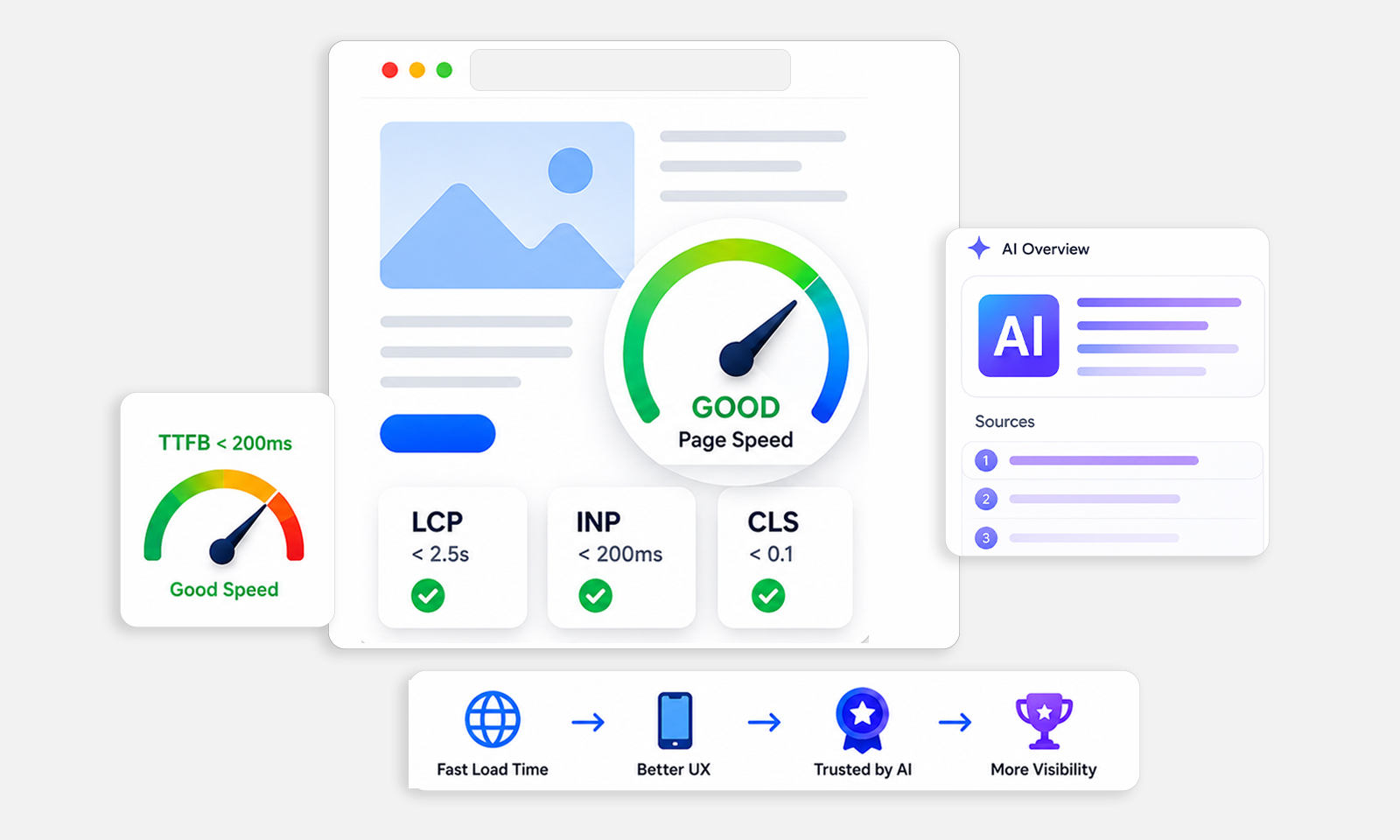
The primary metrics Google uses today are grouped under Core Web Vitals:
Only 48% of mobile origins 56% of desktop origins pass all three Core Web Vitals. More than half the mobile web is still falling short, and that gap has direct consequences for rankings and AI visibility.
Why Page Speed Became a Search Ranking Signal
Google formalized Core Web Vitals as ranking signals in 2021. The rationale was straightforward: pages that load slowly, shift unexpectedly, or respond sluggishly to input create poor user experiences, and poor user experiences signal lower content quality to Google’s algorithms.
What many SEOs underestimate is how much weight performance carries in competitive searches. The logic works like this: when two pages cover the same topic at similar depth, with comparable domain authority and backlink profiles, performance becomes the tiebreaker. A page loading in 1.8 seconds generally has an advantage over a page loading in 3.2 seconds when other ranking factors are similar.
The data backs this up. Pages ranking at position 1 are 10% more likely to pass Core Web Vitals scores than pages at position 9. That gap grows in verticals where competition is intense.
Performance as a Credibility Signal
Google doesn’t treat performance purely as a user experience metric. It also treats it as a credibility signal. A page with poor load times, layout instability, and slow interactivity can signal underlying technical issues that affect overall site quality and user experience. In the context of E-E-A-T (experience, expertise, authoritativeness, and trustworthiness), those are the kinds of signals that matter, particularly for competitive topics.
How AI Crawlers Use Website Speed and Technical Signals
Traditional search crawlers like Googlebot are built for patience. They queue pages, schedule recrawls, and work through a site methodically over time. AI crawlers are fundamentally different.
AI systems, including those powering Google’s AI Overviews, as well as platforms like ChatGPT, Perplexity, and Gemini, operate under resource and latency constraints. They prioritize pages that respond quickly, deliver clean HTML, and make content easy to access and interpret. Slow-loading pages, heavy client-side rendering, and other technical issues can make content more difficult to retrieve, process, and surface in AI-generated search experiences.
Why Server Response Time (TTFB) Matters for AI Search
Many AI systems now perform real-time page fetching when generating responses, rather than pulling exclusively from a cached index. That means a slow or intermittently unavailable server doesn’t just hurt a site’s crawl coverage over time, it can cause pages to be missed entirely at the moment a query fires.
For AI search visibility specifically, this makes TTFB one of the most critical metrics to optimize. Discovered Labs recommends targeting TTFB under 200ms, well within Google’s “Good” threshold, for consistent AI crawler accessibility. Anything above 800ms risks content being skipped during real-time retrieval.
The Relationship Between Performance and AI Overview Citations
AI Overviews don’t cite pages at random. They evaluate content quality, authority, structure, and technical accessibility together. Performance is one part of that evaluation, but it’s a part that can silently disqualify otherwise strong content.
Strong technical performance can improve a page’s eligibility for AI-generated search experiences, but it works alongside content quality, authority, relevance, and structured formatting. As AI Overviews take up more SERP real estate, sites that combine strong content with fast, reliable performance are better positioned to compete for both organic visibility and AI citations.
The data on citation overlap with organic rankings is also worth understanding clearly. Ahrefs found that 76% of pages cited in AI Overviews also ranked in the top 10 for the same query. By early 2026, that figure had dropped to 38%, with citations now distributed more broadly, 31% coming from pages ranked 11 to 100, and another 31% from pages outside the top 100 entirely.
This shift matters. It suggests that AI Overview citations are increasingly decoupled from traditional rank position, meaning that content quality, structured formatting, and technical accessibility can earn citations even without a page-one ranking. That raises the stakes for getting technical fundamentals right.
Why PageSpeed Insights Scores Don’t Tell the Full Story
A common misconception is that a high Lighthouse score, say, 90 or above, guarantees strong performance in Google’s eyes. It doesn’t, and understanding why is important for anyone investing in site optimization.
Google uses field data from real users, collected through the Chrome User Experience Report (CrUX), rather than lab scores when evaluating Core Web Vitals for ranking purposes. That means a site can score 95 in PageSpeed Insights under controlled lab conditions and still deliver slow, inconsistent experiences for users on mobile networks or older devices.
The CrUX dataset uses a 28-day rolling window of real-user data. Improvements made today will take roughly four to six weeks to be reflected in Search Console’s Core Web Vitals report and in any ranking changes that follow.
Technical Issues That Reduce SEO and AI Search Visibility
The technical issues below don’t just affect rankings. They can also make it harder for search engines and AI systems to access, understand, and process your content efficiently. Over time, even small performance problems can compound into larger visibility challenges.
Structured Data and Schema Markup: The Technical Bridge to AI Citations
Fast page delivery gets AI crawlers through the door. Structured data helps them understand what they’re looking at once they’re inside. These two factors work together, and neglecting either one leaves visibility on the table.
Pages implementing structured data and FAQ blocks saw a 44% increase in AI search citations compared to pages without them. Pages combining text, images, and structured markup saw 156% higher selection rates in AI Overviews than text-only pages.
AI systems generating answers from multiple sources need to quickly evaluate which pages are authoritative, accurate, and well-organized. Schema markup provides metadata that answers those questions directly, without requiring the AI to infer context from body copy alone.
A clean Article schema, for example, signals authorship, publication date, and content type:
{

  "@context": "https://schema.org",

  "@type": "Article",

  "headline": "Does Website Speed Affect AI Search Rankings and AI Overviews?",

  "author": {

    "@type": "Person",

    "name": "Author Name"

  },

  "datePublished": "2025-06-01",

  "dateModified": "2025-06-10",

  "publisher": {

    "@type": "Organization",

    "name": "Site Name"

  },

  "description": "How website performance shapes AI search rankings and AI Overview citations."

}
A FAQPage schema helps surface content in featured snippets and increases the likelihood of AI citation for specific question-based queries:
{

  "@context": "https://schema.org",

  "@type": "FAQPage",

  "mainEntity": [

    {

      "@type": "Question",

      "name": "Does page speed affect AI Overviews?",

      "acceptedAnswer": {

        "@type": "Answer",

        "text": "Yes. Slow pages are frequently excluded from AI Overview citations because AI crawlers operate on tight timeout windows. Sites with good Core Web Vitals scores are significantly more likely to be cited."

      }

    }

  ]

}
How to Improve Website Speed for AI Search Visibility
None of this requires a full site rebuild. What it requires is a clear priority order.
1. Start with TTFB. Server response time is the highest-leverage fix for AI crawler accessibility. Targeting under 200ms means investing in quality hosting infrastructure, server-side caching, and CDN deployment. This is the step most teams skip because the benefit isn’t immediately visible to human users, but it’s the one AI crawlers notice most.
2. Audit field data, not Lighthouse scores. Google Search Console’s Core Web Vitals report shows actual CrUX field data, which is what Google uses for ranking. Lab scores from PageSpeed Insights are a useful diagnostic tool, but field data is what determines outcomes.
3. Reduce HTML payload size. Pages above 1MB are at meaningful risk of timing out AI crawlers before they can index the content. Code cleanup, removing unused scripts, and moving to server-side rendering where possible are the most direct paths to reduction.
4. Compress and format images properly. Unoptimized images remain one of the most common causes of poor LCP scores. WebP format combined with lazy loading for offscreen images makes a measurable difference, particularly on mobile.
5. Eliminate render-blocking resources. Deferring non-critical JavaScript and inlining critical CSS allows both browsers and crawlers to begin reading page content faster. This directly affects how quickly AI bots can parse and index a page.
6. Implement structured data before publishing. Schema markup works best when it’s part of the content creation workflow rather than an afterthought. Article, FAQPage, and Organization schemas are a practical baseline for most sites.
7. Monitor on a regular cadence. Performance fluctuates with traffic patterns, third-party script additions, and content changes. Regular checks with Search Console catch regressions before they compound into ranking or visibility drops.
Wrapping Up
Website speed and AI search visibility aren’t separate disciplines that can be optimized in isolation. They’re connected at a technical level that’s becoming clearer as AI-generated search results take up more space on the page.
Pages that load fast, respond quickly, deliver stable layouts, and communicate their structure through schema markup give AI systems everything they need to select them as sources. Pages that don’t, even if their content is strong, face growing disadvantages as more search experiences are shaped by AI rather than traditional ranking algorithms.
FAQs
Does page speed directly affect whether a site appears in AI Overviews?
What TTFB should sites target for AI search visibility?
Is a high Lighthouse score enough to rank well in AI Overviews?
Does schema markup increase AI Overview citations?
How long do performance improvements take to impact AI search visibility?
Is website speed a Google AI Overview ranking factor?
About the Author