






TL;DR: Optimizing landing page experience improves conversions and SEO by focusing on speed, UX, Core Web Vitals, and intent-driven content. Learn methods of landing page optimization for speed, SEO, and mobile-first UX, to increase engagement, and drive sustainable organic and paid performance.
Landing page experience optimization determines how effectively a page turns incoming traffic into meaningful action. When users land on a page from ads, search results, or external links, they make split-second decisions based on loading speed, clarity, and ease of interaction.
Pages that feel slow, confusing, or misaligned with intent lose users quickly, while pages built around performance, usability, and relevance guide visitors toward conversion. Optimizing the landing page performance ensures that every interaction supports both user expectations and business goals.
What Is Landing Page Experience Optimization?
Landing page experience optimization is the practice of refining a page so that it loads quickly, feels intuitive to use, aligns with visitor intent, and ranks well in search engines. It combines three core pillars:
- Speed: How fast the page loads and becomes interactive.
- User Experience (UX): How easy and intuitive the page feels to visitors.
- SEO: How effectively the page attracts organic traffic and aligns with search intent.
These elements work together to reduce friction, improve engagement, and ultimately increase conversions. A slow, cluttered, or irrelevant landing page can deter conversions even if the offer itself is compelling.
How Google Evaluates Landing Page Experience
Google evaluates landing page performance as part of its broader Page Experience system, which assesses how users interact with a page beyond just content relevance. This evaluation combines Core Web Vitals, mobile usability, HTTPS security, and real-user engagement signals to determine whether a page provides a high-quality experience.
Landing pages that load quickly, respond instantly to interactions, and remain visually stable are more likely to perform better in search results because they align with Google’s goal of delivering helpful, user-first content. Poor performance metrics, on the other hand, signal friction and dissatisfaction, which can limit visibility even when content is relevant.
Why Landing Page Optimization Matters for Conversion?
Landing page optimization plays a critical role in SEO because search engines increasingly evaluate how real users experience a page, not just what the page says. Pages that load quickly, respond smoothly to interactions, and satisfy search intent send strong quality signals that support higher rankings, better visibility, and sustained organic traffic growth.
1. Reduces Friction
Offering a clear, singular goal, like a purchase or signup, with a strong call-to-action (CTA) reduces cognitive load and distractions, making it easier for users to complete the desired action. Streamlined pathways improve conversion rates significantly.
2. Increases Relevance
Matching page content with an ad or search query ensures visitors see what they expect, reducing bounce rates and engaging users with immediate relevance.
3. Builds Trust
Professional design, credible messaging, and smooth interactions enhance user confidence. Trust signals like testimonials, secure badges, and concise value propositions improve conversion likelihood.
4. Improves Ad Performance and Quality Score
Landing page experience plays a critical role in paid campaign efficiency. Pages that load faster, align closely with ad intent, and provide smooth interactions tend to achieve higher Quality Scores in platforms like Google Ads.
Higher Quality Scores can lower cost-per-click, improve ad visibility, and generate more conversions from the same ad budget, making landing page optimization a key lever for paid marketing success.
How Landing Page Experience Affects Conversions?
The impact of landing page experience on conversions becomes clearer when you compare poor versus optimized user experiences, revealing how performance and usability directly shape user behavior and outcomes.
| Landing Page Factor | Poor Experience Outcome | Optimized Experience Benefit |
|---|---|---|
| Page Load Speed | High bounce rate | Higher engagement and faster conversions |
| Mobile Usability | Abandonment on small screens | Increased mobile conversion rate |
| Interaction Speed (INP) | Delayed clicks and form inputs | Smooth, real-time user interactions |
| Visual Stability | Mis-clicks and frustration | Consistent layout and user confidence |
| CTA Clarity | Confusion and hesitation | Clear direction toward conversion |
Why Landing Page Optimization Matters for SEO?
Landing page optimization matters because search engines prioritize pages that deliver fast load times, strong user engagement, and clear relevance to search intent. Well-optimized landing pages send positive quality signals that help improve rankings, visibility, and organic traffic.
1. Signals Quality to Search Engines
Google’s Core Web Vitals (a set of real-world user experience metrics) are part of its ranking algorithm. Pages that load quickly, respond promptly, and remain visually stable are more likely to rank well because they offer a superior user experience.
2. Supports Keyword Targeting
Optimized landing pages for specific niche intent keywords help attract highly relevant organic traffic, visitors who are more likely to convert because the content matches their search intent.
3. Increases Organic Entry Points
Each optimized landing page creates an additional opportunity to appear in search results for different queries, increasing organic visibility and reach.
4. Drives Sustainable Organic Traffic
Unlike paid campaigns that stop driving traffic when budgets end, SEO-focused landing pages continue attracting visitors over time, helping establish long-term, cost-effective lead generation.
Optimized pages perform better because they meet Page Experience expectations, particularly Core Web Vitals thresholds. Pages that consistently deliver fast load times, responsive interactions, and visual stability are more likely to maintain rankings over time, even in competitive search environments.
Key Elements of a High-Performing Landing Page Experience
To maximize conversions, landing page experience optimization should focus on the following critical elements:
1. Fast Page Speed and Performance
Fast-loading landing pages reduce bounce rates and keep users engaged from the first interaction. Strong landing page performance ensures visitors can view content and take action without delays, which directly impacts both conversions and search rankings.
2. Clear and User-Centered UX
A user-centered experience makes it easy for visitors to understand the offer, navigate the page, and complete the intended action. Clear layouts, intuitive navigation, and logical content flow reduce confusion and improve engagement.
3. Search-Focused SEO
Search-focused SEO ensures the landing page aligns with search intent, uses relevant keywords naturally, and is structured for crawlability. Proper on-page optimization helps attract qualified organic traffic that is more likely to convert.
4. Core Web Vitals Compliance (Including INP Optimization)
Core Web Vitals are Google’s primary metrics for measuring real-user landing page performance. They focus on three dimensions that directly affect how users perceive performance:
- Largest Contentful Paint (LCP): Measures how quickly the main content becomes visible.
- Interaction to Next Paint (INP): Measures responsiveness to user interactions.
- Cumulative Layout Shift (CLS): Measures visual stability during load.
5. Conversion-Focused Design and Messaging
Conversion-focused design emphasizes clarity, trust, and persuasion without overwhelming users. Strong headlines, visible CTAs, and supportive messaging guide visitors toward action while reinforcing confidence in the offer.
Core Web Vitals Benchmarks for Landing Page Experience
Pages that meet recommended thresholds across all these metrics tend to retain users longer and perform better in competitive search results. INP optimization is especially important for landing pages that rely on forms, buttons, and interactive elements, as slow interaction feedback creates frustration even on fast-loading pages.
| Metric | What It Measures | Recommended Threshold | Why It Matters for Landing Pages |
|---|---|---|---|
| LCP (Largest Contentful Paint) | Loading speed of main content | ≤ 2.5 seconds | Faster content visibility reduces bounce rates and improves first impressions |
| INP (Interaction to Next Paint) | Responsiveness to user actions | ≤ 200 ms | Ensures buttons, forms, and CTAs respond instantly |
| CLS (Cumulative Layout Shift) | Visual stability during load | ≤ 0.1 | Prevents layout shifts that disrupt user actions |
| TTFB (Supporting Metric) | Server response time | ≤ 800 ms | Faster servers improve overall landing page performance |
Landing Page Experience Signals That Influence Rankings
While landing pages are often designed for conversion, they also act as ranking entry points. Google evaluates the following experience signals when determining visibility:
- Real-user Core Web Vitals performance
- Mobile usability and layout stability
- Engagement signals such as bounce behavior and time on page
- Content relevance matched to search intent
- Interaction responsiveness, measured through INP
Optimizing these signals ensures landing pages satisfy both search engines and users, improving long-term organic performance.
12 Best Practices to Optimize Your Landing Page
Below are practical, data-backed strategies that improve final page experience by enhancing speed, usability, and search visibility. These tips focus on reducing friction, improving performance metrics, and guiding users smoothly toward conversion, making them essential for high-performing landing pages.
1. Image Optimization
Images often account for the largest share of a landing page’s total file size, making them a major contributor to slow load times. Proper image optimization improves landing page speed, reduces bounce rates, and enhances overall landing page performance without sacrificing visual quality.
How to implement image optimization:
- Resize images to match their display dimensions (avoid oversized uploads)
- Use modern image formats like WebP or AVIF, where supported
- Compress images without visible quality loss
- Serve responsive images using srcset for different screen sizes
- Avoid using images for text-heavy content when possible
2. Improving Core Web Vitals
Core Web Vitals measure how real users experience your landing page in terms of loading speed, interactivity, and visual stability. Strong Core Web Vitals scores signal a high-quality landing page performance and directly influence both SEO visibility and conversion performance.
How to improve Core Web Vitals:
- Optimize LCP by prioritizing above-the-fold content and optimizing hero images
- Improve INP by reducing JavaScript execution and improving interaction handling
- Prevent CLS by setting explicit width and height attributes for images and embeds
- Avoid injecting dynamic content that shifts layouts after page load
- Monitor field data regularly using PageSpeed Insights and Search Console
3. JavaScript and CSS Optimization
Excessive or poorly managed JavaScript and CSS can block rendering and delay interactivity, making the landing page feel slow. Optimizing these assets improves load speed and responsiveness, which is critical for both UX and INP optimization.
How to optimize JavaScript and CSS:
- Minify JavaScript and CSS files to reduce file size
- Defer non-critical JavaScript execution
- Remove unused CSS and JavaScript libraries
- Inline critical CSS needed for above-the-fold content
- Break large JavaScript bundles into smaller chunks
4. Server and Hosting Improvements
Even a well-optimized landing page can perform poorly if server response times are slow. Reliable hosting and fast backend performance reduce latency and improve time-to-first-byte (TTFB), which affects both speed metrics and user perception.
How to improve server and hosting performance:
- Choose performance-optimized hosting with adequate resources
- Reduce server response time by optimizing backend processes
- Use HTTP/2 or HTTP/3 where available
- Implement a Content Delivery Network (CDN) to serve assets closer to users
- Regularly monitor uptime and server performance metrics
5. Lazy Loading and Caching
Lazy loading and caching reduce unnecessary resource loading and repeated downloads. These techniques improve both perceived and actual page speed, especially for image-heavy or content-rich landing pages.
How to implement lazy loading and caching:
- Enable native lazy loading for images and iframes
- Load below-the-fold assets only when needed
- Use browser caching for static assets like images, CSS, and JavaScript
- Set appropriate cache-control headers
- Use server-side or plugin-based caching where applicable
6. Clear Visual Hierarchy and Content Structure
A strong visual hierarchy helps users quickly understand the offer and navigate the page without confusion. Clear structure improves readability, reduces cognitive load, and directs attention toward conversion actions.
How to improve visual hierarchy:
- Use a clear, benefit-driven headline at the top
- Organize content using logical headings and spacing
- Highlight key value propositions visually
- Keep CTAs visually distinct and easy to locate
- Avoid clutter by limiting unnecessary design elements
7. Mobile-First UX for Landing Pages
With mobile traffic dominating most industries, a mobile-first approach is essential. Poor mobile UX leads to higher bounce rates and lost conversions, even if the desktop experience is strong.
How to optimize mobile UX:
- Design layouts for small screens first, then scale up
- Use large, tap-friendly buttons and CTAs
- Ensure text is readable without zooming
- Simplify navigation and forms for mobile users
- Test landing pages across multiple devices and screen sizes
8. Trust Signals, CTAs, and Conversion-Focused Design
Trust is a key factor in conversion decisions. Landing pages that clearly communicate credibility and guide users toward action perform better than pages that rely solely on persuasive copy.
How to strengthen trust and conversions:
- Add testimonials, reviews, or case studies near CTAs
- Display security badges or certifications where relevant
- Use clear, action-oriented CTA language
- Place primary CTAs above the fold and reinforce them throughout the page
- Avoid aggressive or misleading design patterns
9. Reducing Friction in Forms and Interactions
Every additional step or required field increases the chance of abandonment. Reducing friction makes it easier for users to complete forms and interactions without hesitation.
How to reduce interaction friction:
- Limit form fields to only essential information
- Enable autofill and input validation
- Use inline error messages instead of page reloads
- Break long forms into smaller steps when necessary
- Clearly explain why sensitive information is required
10. INP Optimization: Improving Real User Interactions
INP measures how quickly a landing page responds to user actions such as clicks, taps, and form inputs. Poor INP makes pages feel sluggish, even if they load quickly.
How to optimize INP:
- Reduce long JavaScript tasks that block the main thread
- Defer non-essential scripts until after interaction
- Optimize event handlers for faster response times
- Remove unnecessary third-party scripts
- Monitor interaction delays using performance tools
11. Content Optimization Without Hurting UX
SEO-driven content should enhance clarity, not overwhelm users. Effective landing page SEO optimization balances keyword relevance with readability and user intent.
How to optimize content safely:
- Use primary and secondary keywords naturally
- Write concise, intent-focused copy
- Structure content with clear headings and bullet points
- Avoid keyword stuffing or excessive repetition
- Align content closely with the visitor’s search intent
12. A/B Testing Everything
Optimization is an ongoing process, not a one-time task. A/B testing validates decisions with real data and helps identify what actually improves conversions.
How to approach A/B testing:
- Test one variable at a time (headline, CTA, layout, color)
- Run tests with sufficient traffic for reliable results
- Measure both conversion rate and engagement metrics
- Apply winning variations gradually
- Continuously iterate based on performance data
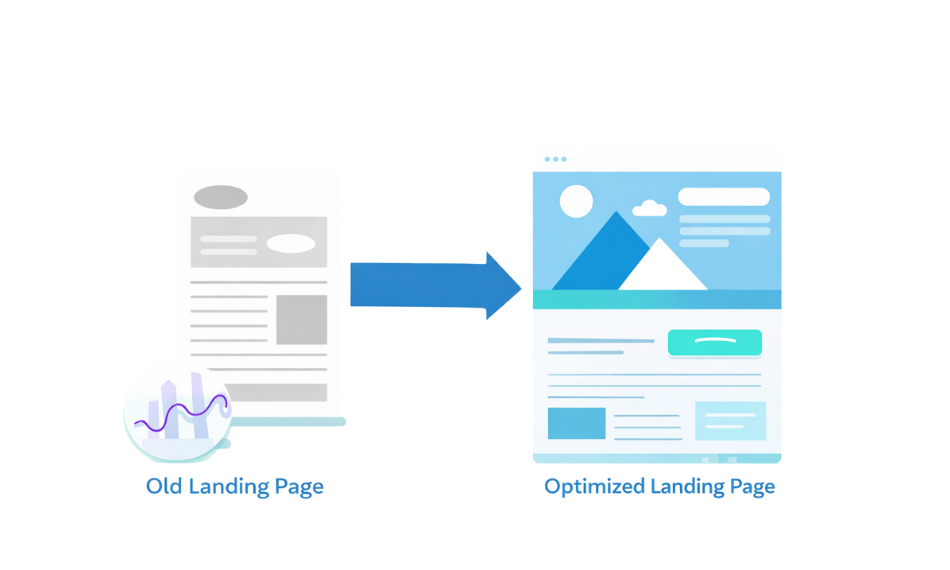
Before vs After: How Optimization Changes Landing Page Outcomes
A landing page that loads slowly, shifts visually, or delays interaction often experiences higher bounce rates and lower conversion efficiency. After implementing landing page speed optimization, UX improvements, and INP optimization, pages typically show:
- Faster initial content visibility
- Smoother form and button interactions
- Improved mobile engagement
- Higher trust and completion rates
These improvements compound over time, strengthening both SEO performance and conversion reliability without requiring a full redesign.
How to Test and Validate Your Landing Page Experience
Accurate measurement is essential for successful landing page performance refinement:
PageSpeed Insights
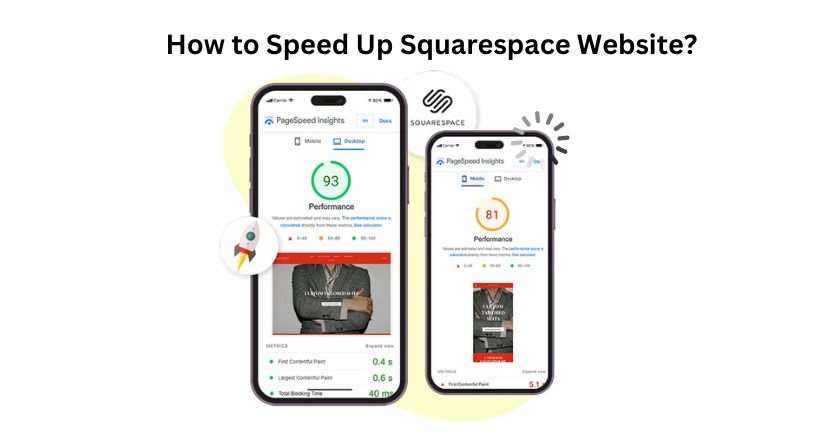
It provides both lab and real-world (field) data for Core Web Vitals, helping identify how actual users experience your landing page. PageSpeed Insights highlights specific speed and performance issues that impact optimizing the landing page performance.
Lighthouse
This tool runs in-depth audits for performance, accessibility, SEO, and best practices, offering actionable recommendations for technical improvements. Lighthouse reports help prioritize fixes that enhance landing page speed, UX, and overall performance.
Google Analytics 4 (GA4)
Tracking tool GA4 helps track real user behavior on landing pages by measuring engagement time, bounce-related signals, and device-specific performance. Google Analytics 4 connects technical improvements with actual user outcomes, making it easier to understand how optimizing landing page performance impacts conversions and engagement.
Common Landing Page Experience Mistakes to Avoid
Common landing page mistakes can quietly undermine performance, even when traffic and offers are strong. Identifying and avoiding these issues is essential for maintaining speed, usability, and conversion-focused experiences.
1. Overloading Scripts
Too many third-party scripts (tags, ads, widgets) slow down load and responsiveness, hurting both speed and UX.
2. Ignoring Mobile UX
If mobile users struggle with gestures or layouts, they’ll abandon the page, and Google favors mobile-friendly pages for rankings.
3. Focusing Only on SEO, Not Users
SEO alone can attract visitors, but without UX and speed, users won’t convert. Balance content relevance with experience.
4. Slow Third-Party Tools
Widgets like chat popups and tracking scripts add latency; load them after the critical content to minimize impact.
Conclusion
Landing page experience optimization is something you cannot take for granted, as it is necessary for both conversions and search performance. Pages that load quickly, respond smoothly, and align with user intent not only reduce bounce rates but also build trust, improve ROI on ads, and drive sustainable organic traffic.
By implementing the techniques above, from landing page speed optimization and landing page UX best practices to landing page SEO optimization and INP optimization, you’ll create experiences that delight both users and search engines, ultimately driving more conversions. Ready to optimize? Start with data, implement systematically, and test every change.
Frequently Asked Questions (FAQs)
Q1: Is landing page experience a Google ranking factor?
Q2: What is a good INP score for landing pages?
Q3: Does landing page speed affect Google Ads Quality Score?
Q4: Can landing page optimization improve SEO without redesigning the page?
Q5: Which landing page elements impact conversions the most?
About the Author