






TL;DR: If your Meta Ads CPC increased while conversions dropped, don’t assume your campaign settings are the problem. Auction competition, lower CTR, audience changes, tracking issues, and landing-page friction can all contribute. Compare CPM, CTR, CPC, conversion rate, and mobile page performance to identify where the decline actually starts.
When Meta Ads CPC increased and conversions dropped at the same time, you may assume something changed inside your campaign. But even without changing your targeting, budget, or ads, the advertising environment and your website experience can change.
More competition can make impressions more expensive. Creative fatigue can reduce CTR. Tracking problems can make conversions appear lower than they are. And a slow or difficult landing page can turn paid clicks into lost opportunities.
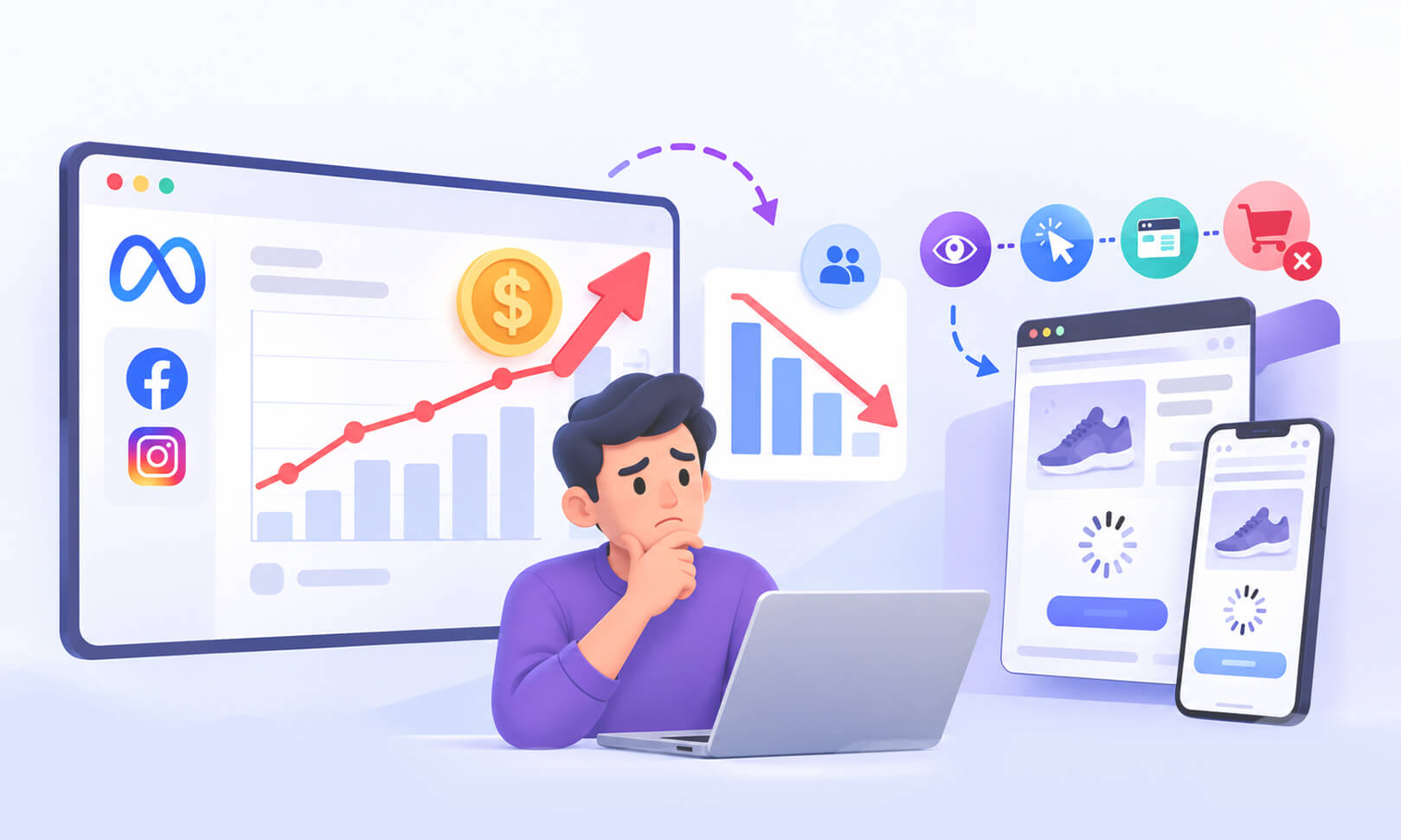
The quickest way to find the problem is to follow the entire journey: impression → click → landing page → interaction → conversion.
What Could Be Affecting Your Meta Ad Performance?
When Meta ad performance changes, look beyond CPC alone. Compare CPM, CTR, conversion rate, landing-page experience, mobile performance, and tracking to identify where the problem begins.
| What you see | What to investigate |
|---|---|
| CPC increased | CPM, CTR, auction competition |
| CTR decreased | Creative fatigue, message, audience |
| Clicks remain stable, but conversions fall | Landing page, offer, checkout |
| Mobile conversions fall more than desktop | Mobile speed and UX |
| Reported conversions suddenly fall | Pixel, Conversions API, analytics |
| CPM increases while CTR stays stable | More expensive impressions or auction pressure |
Meta’s advertising system operates through an auction, so costs and delivery can change even when you haven’t manually changed your campaign.
Why Can Meta Ads CPC Increase Without Campaign Changes?
Your campaign settings are only one part of the equation. CPC is closely related to both CPM and CTR. As a simplified relationship, CPC ≈ CPM ÷ (1,000 × CTR). That means CPC can rise if impressions become more expensive, if fewer people click the ad, or if both happen at the same time.
For example, if CPM increases while CTR remains relatively stable, CPC can still rise. If CPM stays relatively stable but CTR falls, CPC can also increase because fewer clicks are generated from the same number of impressions.
For example, if CPM rises from $10 to $12 while CTR stays at 1%, CPC can increase because every 1,000 impressions costs more. If CPM stays at $10 but CTR falls from 1% to 0.8%, CPC can also increase because fewer clicks come from the same number of impressions.
| Metric | If it changes | What to check |
|---|---|---|
| CPM ↑ | Impressions cost more | Auction and audience |
| CTR ↓ | Fewer users click | Creative and message |
| CPC ↑ | Clicks cost more | CPM and CTR together |
| Conversion rate ↓ | Fewer clicks convert | Landing page, offer, tracking |
| CPA ↑ | Acquisition becomes more expensive | Overall funnel |
So, don’t diagnose Meta Ads CPC increased by looking at CPC alone. Compare it with CPM, CTR, and conversion rate.
Why Are Meta Ad Clicks Not Turning Into Conversions?
A click only shows that someone decided to visit your website. It doesn’t mean the visitor found the page relevant, fast, trustworthy, or easy to use. Consider a simple example.
Your Meta ad promises a discount on a specific product. A visitor clicks but lands on a page that takes several seconds to become usable, displays unrelated content first, or makes the visitor search for the advertised offer.
The ad generated the click. The landing-page experience lost the conversion. When Meta ad clicks are not turning into conversions, compare these stages:
Ad → Click → Landing-page view → Engagement → Form/Checkout → Conversion
If clicks remain healthy but conversions decline, investigate what happens after the click before assuming the campaign itself has failed.
Could Your Landing Page Be Causing the Conversion Drop?
Yes. Your landing page can affect the value you get from your advertising traffic even when the ad is performing normally. Start with three areas:
Message match
The page should immediately reinforce what the ad promised. If someone clicks an ad for a particular product or offer, they shouldn’t have to hunt for it after arriving.
Mobile experience
Check whether the page works comfortably on smaller screens. Buttons should be easy to tap, text should be readable, and important information should appear without unnecessary scrolling.
Conversion friction
Look at the actual conversion process. Long forms, unexpected costs, intrusive pop-ups, confusing navigation, or a difficult checkout can all create friction. A strong landing page experience can make it easy for visitors to understand the offer and complete the desired action.
Can Landing Page Speed Affect Meta Ads Conversions?
Yes, although you should distinguish between higher advertising costs and lower post-click conversion rates. A slow landing page doesn’t automatically mean Meta will increase your CPC. Instead, it can reduce the percentage of paid visitors who actually convert.
For example:
- 1,000 clicks at a 5% conversion rate = 50 conversions
- 1,000 clicks at a 3% conversion rate = 30 conversions
You paid for the same number of clicks, but the business outcome changed. Google’s research shows that longer mobile load times are associated with higher bounce probability.
Real-world case studies have also documented improvements in business metrics alongside better Core Web Vitals. For example, Nuvemshop reported an increase in mobile conversion rate alongside improvements in LCP and other performance metrics.
These results don’t mean a particular speed improvement will produce the same conversion increase for every website. They do show why performance is worth investigating when paid traffic is reaching your page but not converting.
Can Mobile Page Speed Affect Ad Conversions?
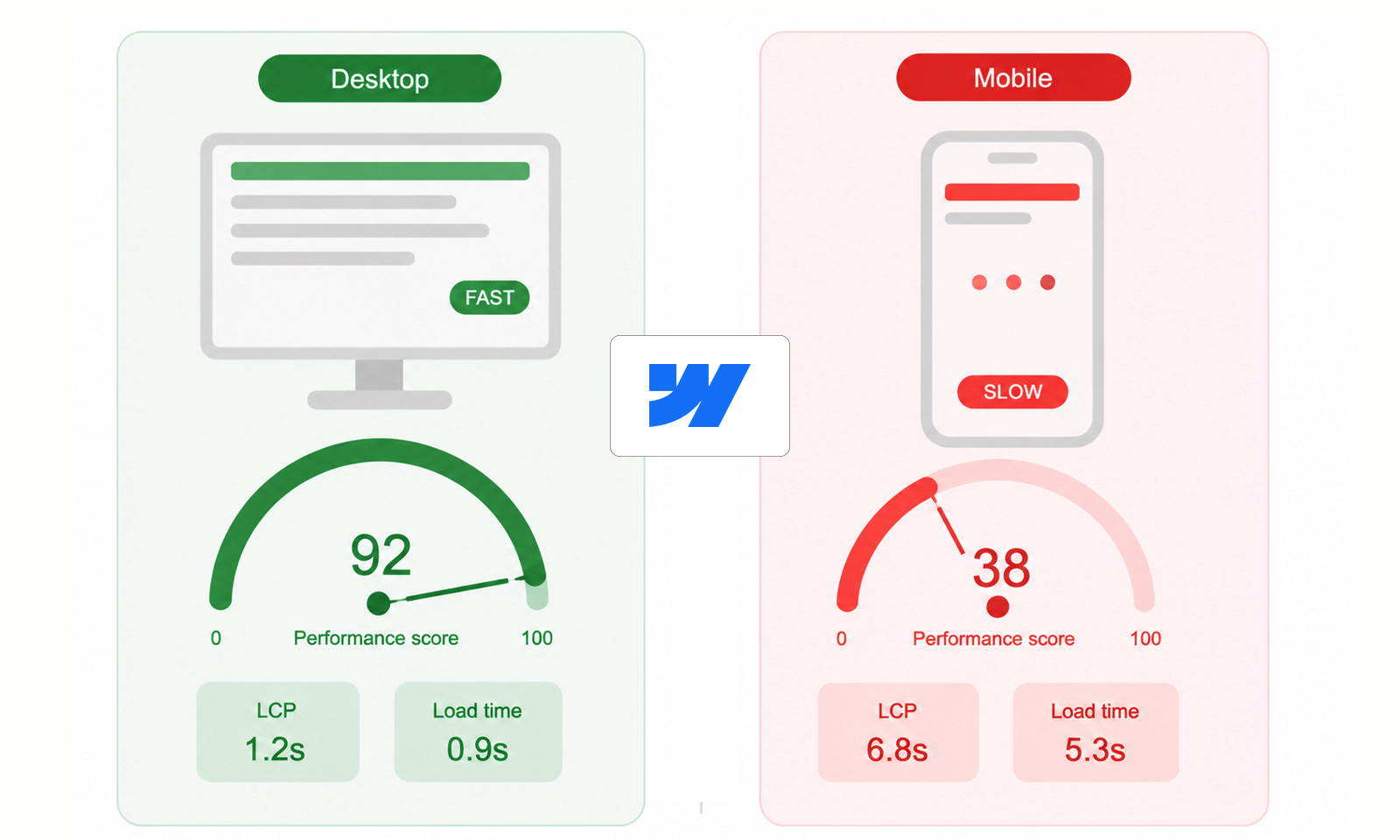
It can, particularly when a large portion of your Meta traffic comes from mobile devices. Don’t assume a page that performs well on your desktop is performing equally well on a smartphone.
Mobile devices may have less processing power and slower network conditions, while complex pages can require significant JavaScript and image resources.
Check:
- LCP: How quickly the main content appears.
- INP: How quickly the page responds to interactions.
- CLS: Whether the layout shifts unexpectedly.
- Large images and unnecessary scripts.
- Third-party widgets and tracking scripts.
- Server response time.
Google’s Core Web Vitals guidance emphasizes real-world user experience, so use field data alongside lab diagnostics when evaluating page performance.
How to Find the Actual Cause of the Conversion Drop
Before changing your Meta campaign, work through the funnel in order. The goal is to identify whether the problem starts with the ad, the traffic, the landing page, or the conversion tracking.
1. Compare CPM, CTR, and CPC
If CPM increased while CTR remained relatively stable, investigate auction and audience conditions. If CTR declined, examine your creative, message, frequency, and audience.
2. Compare clicks with landing-page views
A large or unexpected gap between link clicks and landing-page views can be a useful diagnostic signal. Investigate loading problems, tracking discrepancies, or visitors leaving before the page becomes usable.
3. Compare conversion rates by device
If desktop conversions remain stable while mobile conversions decline, investigate mobile performance and usability.
4. Test the actual landing page
Use Google PageSpeed Insights to inspect the exact URL receiving your ad traffic. Look at the actual mobile experience, not just the overall score. Pay particular attention to LCP, INP, CLS, image weight, JavaScript, and third-party resources.
5. Check conversion tracking
A reporting problem can look exactly like a conversion problem. Before concluding that sales have actually declined, check your Meta Pixel, Conversions API, analytics events, thank-you pages, and attribution setup.
6. Fix the weakest stage first
If impressions are expensive, investigate the advertising environment. If CTR has fallen, investigate the ad. If clicks are healthy but conversions have fallen, investigate the landing page, offer, checkout, and tracking. If mobile performance is the obvious difference, prioritize the mobile experience.
Conclusion
When Meta Ads CPC increased and conversions dropped, don’t treat CPC as the entire problem.
The change could come from higher auction costs, weaker ad engagement, audience shifts, tracking issues, or a landing page that isn’t converting the traffic you’re paying for.
By comparing CPM → CTR → CPC → landing-page behavior → conversion rate, you can identify where the decline actually begins. If clicks remain steady but conversions fall, especially on mobile, your landing-page speed and user experience deserve just as much attention as your Meta campaign settings.
Frequently Asked Questions
Why did my Meta Ads CPC suddenly increase?
Why are my Meta ad clicks not converting?
Can a slow landing page increase Meta Ads CPC?
Can landing page speed affect Meta Ads conversions?
Can mobile page speed affect ad conversions?
Should you change your Meta campaign when conversions suddenly drop?
About the Author