






TL;DR: Shopify speed optimization directly impacts user experience, conversions, and search visibility. A slow store can make shoppers wait for products, images, and interactive elements to load, which can hurt engagement and sales. This guide covers practical Shopify speed optimization tips, from image optimization and lazy loading to app audits, JavaScript, Core Web Vitals, and page-specific performance improvements.
Shopify image optimization plays a critical role in how fast your store feels to visitors. Even the most beautifully designed Shopify store with great products and strong branding can feel frustrating if it loads slowly. When pages take too long to appear, shoppers don’t wait, they leave. That’s why optimizing performance is essential for every Shopify store.
The good news is that Shopify already handles much of the underlying infrastructure, including CDN delivery, and several image and asset optimizations. Your biggest opportunities are usually in the parts you control: theme code, apps, third-party scripts, images, sections, and page complexity. Before changing anything, measure your store first, so you know which problem actually needs attention.
Prefer learning visually? Here’s a helpful video that explains how to boost your Shopify store’s performance and deliver a smoother shopping experience for your visitors.
Now that you have watched the video, let’s dive deeper.
Quick Shopify Speed Optimization Checklist
Shopify speed optimization starts with identifying the biggest performance bottleneck rather than applying every optimization at once. In 2026, prioritize real-user Core Web Vitals, then address the theme, images, JavaScript, apps, and third-party resources responsible for the largest delays.
- Check real-user performance: Review Shopify’s Web Performance data and Google Search Console before making changes.
- Fix LCP issues: Optimize the hero or main product image and avoid lazy-loading the LCP element.
- Optimize images: Use appropriate dimensions, compression, responsive image delivery, and modern formats.
- Audit apps and scripts: Remove unnecessary apps and identify third-party JavaScript that affects loading or interactions.
- Improve INP: Reduce unnecessary JavaScript, long tasks, and heavy event handlers.
- Prevent CLS: Reserve space for images, banners, fonts, and dynamically loaded content.
- Optimize the theme: Simplify Liquid logic and remove unnecessary CSS, JavaScript, and theme features.
- Prioritize mobile: Test important storefront pages under realistic mobile conditions.
- Retest after changes: Use lab tools to diagnose problems and field data to confirm real-world improvements.
Why Speed Optimization Matters for Your Shopify Store in 2026
Shopify speed optimization is crucial for conversions, search visibility, and customer experience. As user expectations and Google’s Core Web Vitals continue to evolve, site performance has become an important part of e-commerce growth. Below are the key reasons why speed optimization matters for your store’s success.
1. Direct Impact on Conversions
E-commerce is driven by immediacy. You want a shopper to check out without any hesitation when they put an item in their cart. A slow page can create friction at exactly the point where a shopper is deciding whether to continue browsing or buy.
Even faster stores have an advantage during high-traffic sales events like Black Friday and Cyber Monday, when more shoppers may be browsing and interacting with your store at the same time. That makes performance something worth monitoring before a major campaign, not something to fix only after problems appear.
2. Core Web Vitals and Search Performance
Core Web Vitals are part of Google’s page-experience signals and are used by its ranking systems. However, good Core Web Vitals do not guarantee higher search rankings. For Shopify stores, the practical goal is to provide a fast, stable, and responsive experience while maintaining strong content, technical SEO, and product relevance.
Improving storefront performance can also make it easier for visitors to browse products, interact with filters and menus, and complete purchases without unnecessary delays.
3. Better Landing-Page Experience
Page performance can affect how visitors interact with paid landing pages. Slow-loading product or landing pages can create friction before shoppers can view products or take action. Improving loading and responsiveness can therefore support a better overall landing-page experience, although it does not guarantee lower advertising costs or higher ad rankings.
4. Mobile Shopping Experience
Mobile shoppers may browse under slower networks and on devices with less processing power than desktop computers. That makes image size, JavaScript execution, layout stability, and interaction responsiveness particularly important.
Test your homepage, product pages, collection pages, and cart experience on mobile rather than assuming that good desktop performance means the store is fast for mobile shoppers.
Shopify Core Web Vitals and Performance Metrics
Core Web Vitals help measure the loading performance, responsiveness, and visual stability of your Shopify storefront. Use them alongside supporting metrics such as TTFB and FCP to understand where performance problems originate. The recommended good thresholds are:
| Metric | What it measures | Good target |
|---|---|---|
| LCP | Loading performance of the main content | ≤ 2.5 seconds |
| INP | Responsiveness to user interactions | ≤ 200 ms |
| CLS | Visual stability during loading | ≤ 0.1 |
These thresholds are evaluated using real-user data at the 75th percentile. Treat them as performance targets, not as a reason to chase a perfect lab score.
Largest Contentful Paint (LCP)
LCP measures how quickly the largest visible content
element is rendered. On Shopify, this is often a hero image, product image, banner, or large text block.
A good LCP is 2.5 seconds or less.
How to improve LCP on Shopify
A poor LCP does not always mean that an image is simply too large. First, identify which element is being measured as the LCP element, then check how quickly the browser discovers and loads it.
Common Shopify causes of poor LCP include:
- An oversized hero or product image
- The LCP image being lazy-loaded
- Render-blocking JavaScript or CSS
- App scripts delaying resource discovery
- Heavy theme sections above the fold
- Animations that hide or delay the LCP element
The LCP image should normally be loaded eagerly rather than lazy-loaded. Where appropriate, Shopify recommends giving the LCP image high fetch priority so the browser can request it early.
Cumulative Layout Shift (CLS)
CLS measures unexpected movement of visible
content while a page loads. Sudden shifts caused by images, fonts, banners, or app content can make a store
difficult to use.
A good CLS is 0.1 or less.
How to Fix CLS on Shopify
If elements move around while the page loads, first identify what is being inserted or resized after the initial page has rendered.
Common Shopify causes include:
- Images without reserved dimensions
- Review and rating widgets
- Promotional banners
- Cookie, chat, or popup elements
- Fonts swapping after the page starts rendering
- App content being injected into the page
For app-powered content, reserve space for the element before the app finishes loading. This prevents the surrounding content from jumping when the widget appears.
Interaction to Next Paint (INP)
INP measures how
responsive your store feels when shoppers interact with buttons, menus, filters, forms, and other interactive
elements. Heavy JavaScript is a common cause of poor INP.
A good INP is 200 milliseconds or less.
How to improve INP on Shopify
A Shopify store can have a good LCP score and still feel slow when shoppers click, tap, filter, or open menus. If INP is poor, look for JavaScript that keeps the browser busy during interactions.
Common sources include theme JavaScript, app scripts, analytics, chat widgets, filters, pop-ups, and other interactive features.
Use Chrome DevTools to identify long tasks and see which scripts are taking the most time. Start with the biggest offenders instead of trying to optimize every script on the page.
Reducing unnecessary JavaScript, delaying non-critical scripts, and simplifying expensive interactions can make the store feel much more responsive.
Time to First Byte (TTFB)
TTFB measures how long it takes for the browser to receive the first byte of a response. It is not a Core Web Vital, but it can help you understand where a slow page may be getting delayed.
On Shopify, TTFB can be affected by how quickly the storefront renders its Liquid code. Complex or deeply nested Liquid loops can increase server-side processing time, which delays the browser from receiving and rendering the page.
Use TTFB as a diagnostic clue rather than a score to chase. If TTFB is slow, investigate the theme and Liquid rendering before assuming that Shopify hosting is the problem.
How to Test Shopify Store Speed Accurately
Before applying any Shopify speed optimization tips, it’s essential to measure your store’s current performance using reliable tools. Speed optimization without testing often leads to unnecessary changes that don’t improve real-world performance.
Use these tools to test the Shopify store speed correctly:
1. Shopify Web Performance Data
Login to your Shopify Admin.
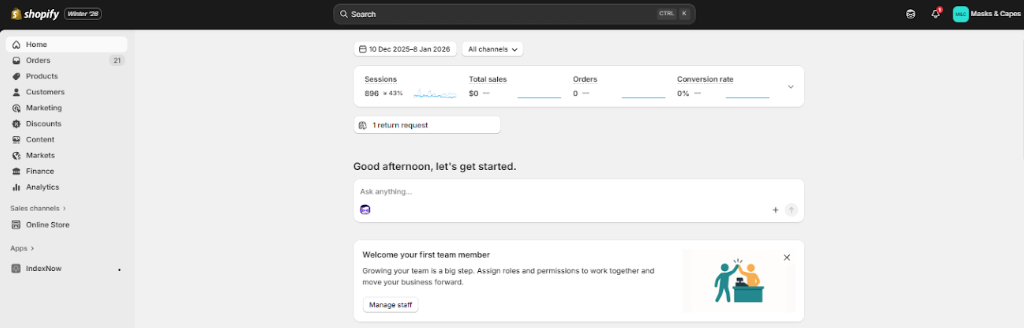
In Shopify Admin, go to Online Store > Themes.
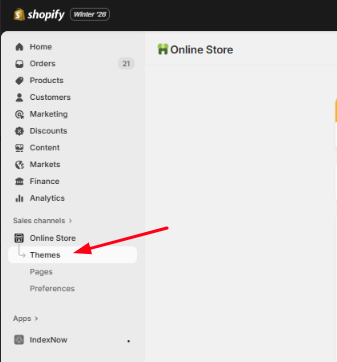
Review the Web Performance information available for your active theme. Use this data to understand how real visitors are experiencing your storefront.
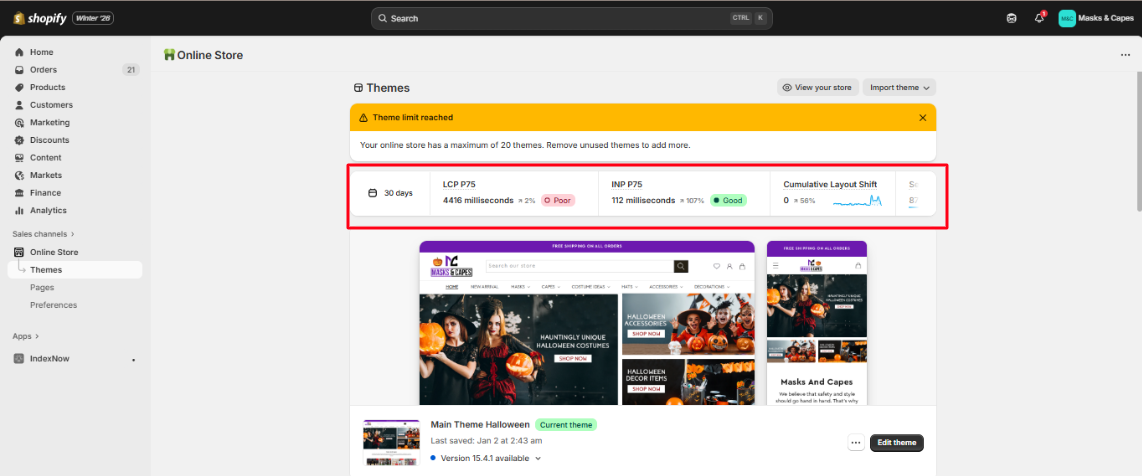
Do not look only at an overall score. Check which Core Web Vitals are failing and whether the problem is concentrated on a particular page type, device, or region.
For example, if product pages have poor INP while your homepage performs well, changing the entire theme may not be the right solution. The problem could be coming from product reviews, recommendation widgets, variant scripts, or other functionality loaded on the product template.
2. Field Data vs. Lab Data: Which Should You Trust?
Shopify’s Web Performance data and tools such as PageSpeed Insights answer different questions.
Field data shows how real visitors experience your store. It can help you see whether LCP, INP, or CLS is actually a problem across different page types, devices, and regions.
Lab data gives you a controlled test that helps you investigate what may be causing the problem. It is useful for looking at the network waterfall, JavaScript execution, render-blocking resources, and other technical issues.
A simple way to use both field data and lab data is: Field data → find the problem → lab data → find the cause → make the fix → field data → verify the improvement.
This is more useful than trying to get a perfect score from one speed test.
3. Google PageSpeed Insights
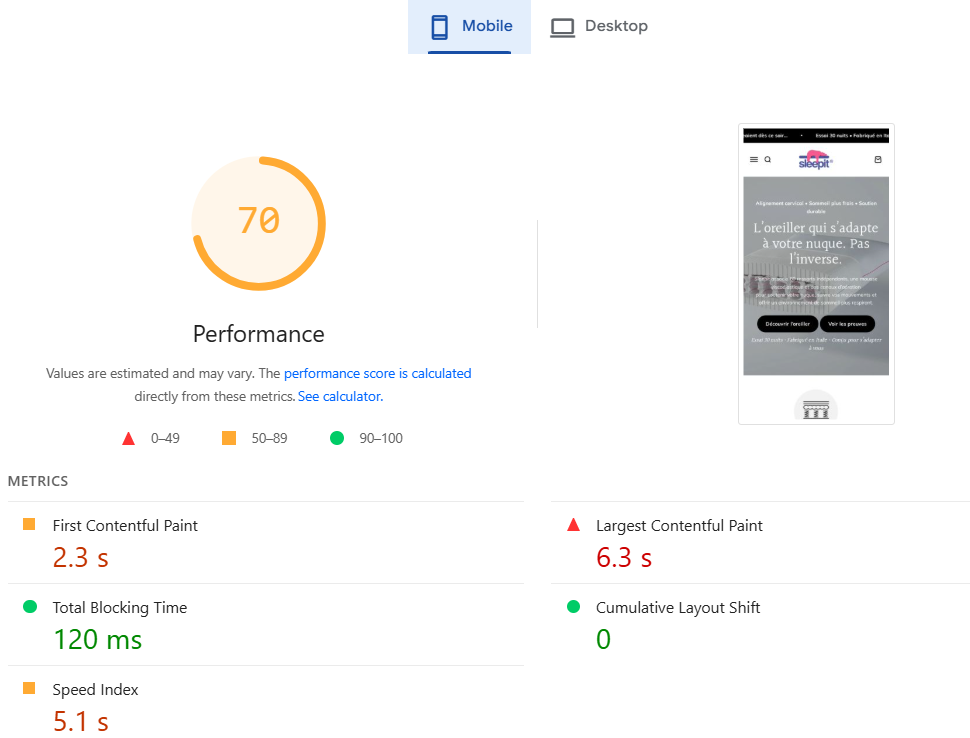
Google PageSpeed Insights is useful for investigating individual pages and finding potential performance problems. It provides lab data for controlled testing and may also show field data when enough real-user data is available. Use it alongside Shopify’s Web Performance data rather than treating the PageSpeed score as the final goal.
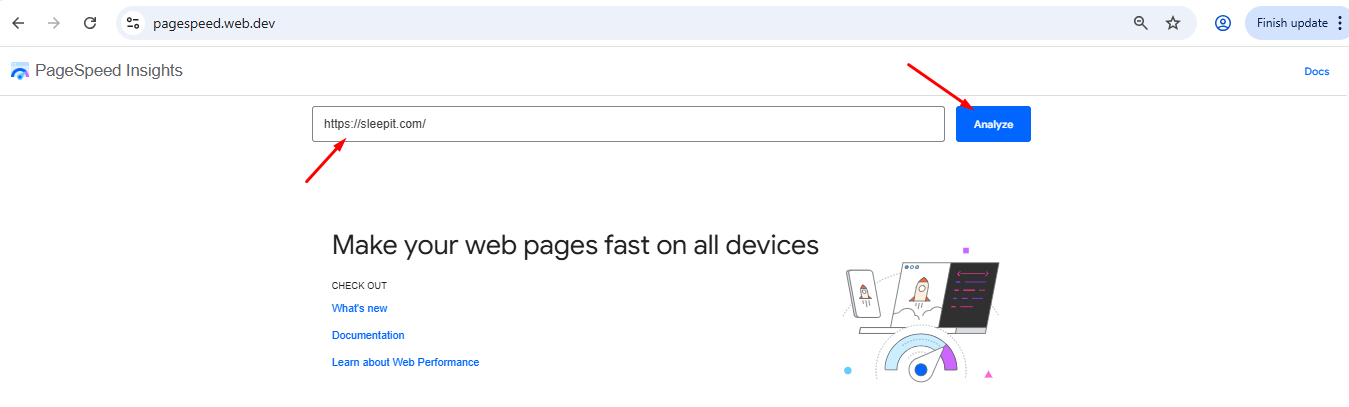
Step 1: Open Google PageSpeed Insights
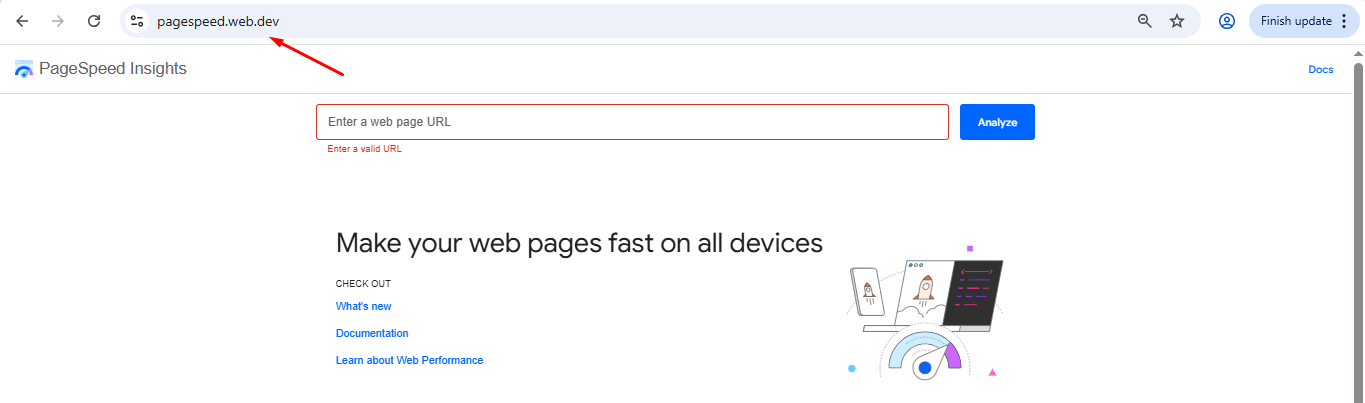
Step 2: Enter your Shopify store URL and click Analyze
Step 3: Review Mobile results and Core Web Vitals metrics
4. GTmetrix
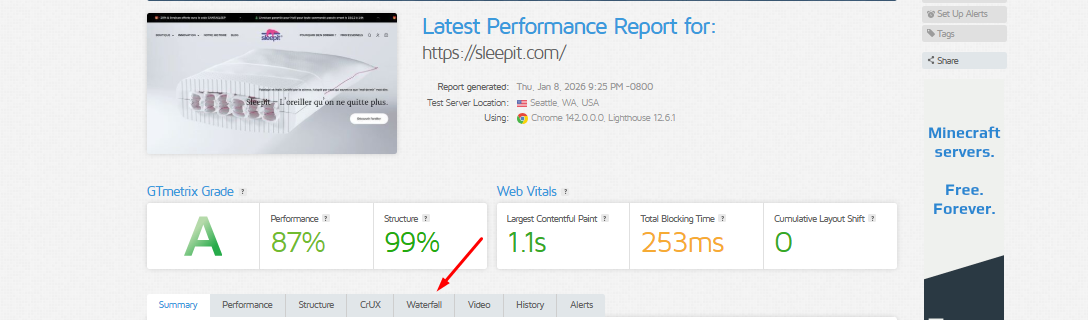
GTmetrix can help identify technical bottlenecks such as render-blocking scripts, unoptimized images, and excessive JavaScript. Its waterfall view is particularly useful when you need to see which resources are loading, how long they take, and which third-party domains are involved.
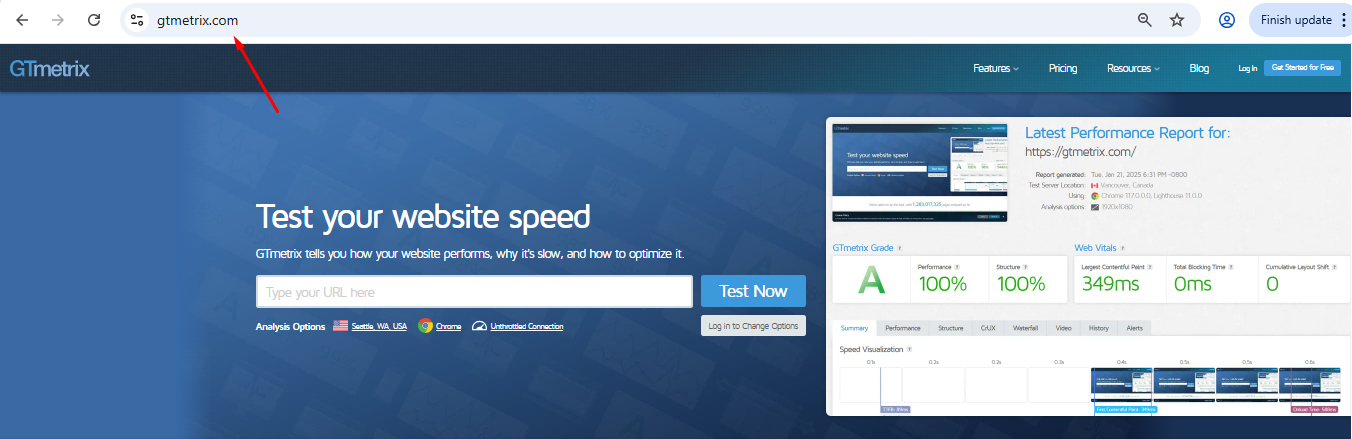
Step 1: Visit GTmetrix
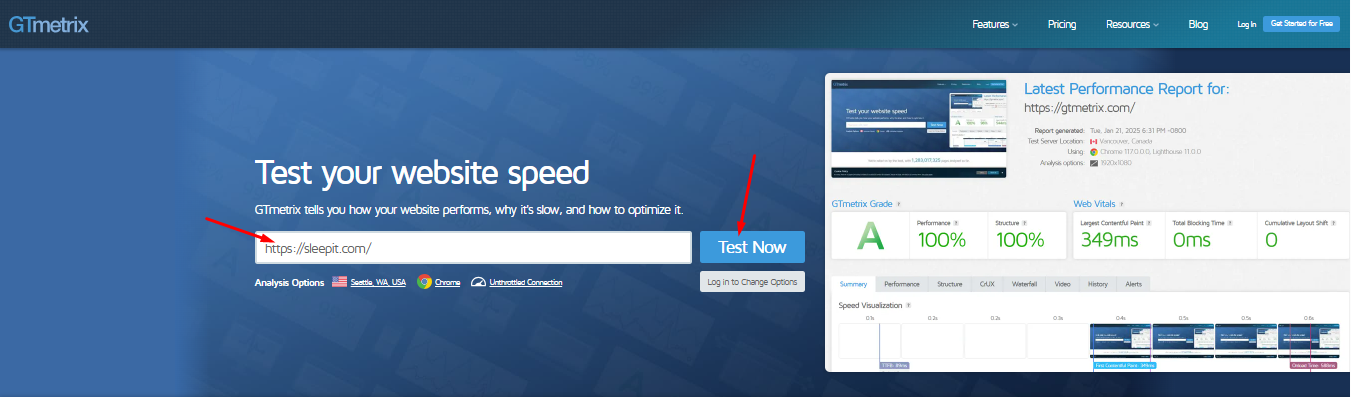
Step 2: Enter your store URL and start the test
Step 3: Check the Waterfall tab for slow-loading files
How to Prioritize Shopify Speed Optimization
Not every performance issue needs to be fixed at the same time. Start with the problems affecting real visitors, then work through the biggest offenders first.
- Check your real-user Core Web Vitals.
- Identify which metric is failing: LCP, INP, or CLS.
- Check which page type is affected.
- Find the apps, scripts, images, or theme code contributing to the problem.
- Fix the biggest performance issue first.
- Test the page again and compare the results.
- Monitor performance after future theme, app, or tracking changes.
This prevents you from spending hours making small improvements while a larger issue is still affecting your customers.
Primary Factors That Influence Shopify Store Speed
The primary factors influencing Shopify store speed include theme architecture, third-party apps and scripts, image and media optimization, custom code, Liquid performance, and page complexity. Shopify already handles much of the underlying infrastructure, so the most useful optimization work usually focuses on what merchants can control.
| Symptom | Likely Cause | What to Check |
|---|---|---|
| Slow homepage | Heavy images, sections, apps, or scripts | Check the first viewport and loaded assets |
| Poor LCP | Late or blocked LCP resource | Identify the LCP element and its loading path |
| Poor INP | Heavy JavaScript or third-party scripts | Check long tasks and script execution |
| High CLS | Images, fonts, banners, or app content shifting | Identify the elements causing layout movement |
| Slow product page | Product media, reviews, recommendations, or app scripts | Audit the product template |
| Slow collection page | Large product grids, filters, images, or apps | Audit the collection template |
| Performance dropped after an app change | New or modified app resources | Compare before and after the app change |
1. Theme Architecture
Themes regulate the appearance and functionality of your store. Excessively complicated themes with bloated code, unnecessary animations, and too many page elements can slow performance. A clean theme with only the functionality you need is easier to optimize and maintain.
2. E-commerce Platform & Hosting
Shopify already provides the underlying storefront infrastructure, including CDN delivery, caching, compression, HTTP/3, and automatic image handling. This means merchants generally should not spend their optimization effort trying to replace Shopify’s hosting infrastructure.
3. Third-Party Apps
Shopify apps can add JavaScript, CSS, app embeds, pixels, and other resources to your storefront. Every application, including those not in use, may generate more HTTP requests. The number of installed apps alone does not tell you how much they affect performance. What matters is what each app loads, where it loads, and how much work it makes the browser do.
4. Content Load (Images, Videos, Fonts)
Large images, autoplaying videos, unnecessary embeds, and web fonts can all add to the amount of work and data required to render a page. Optimize these resources based on how and where they are used rather than applying the same rule to every page.
5. Custom Code and Liquid
Too many Liquid loops, inefficient theme logic, JavaScript errors, unnecessary CSS, and client-side rendering of content that could be rendered in Liquid can all affect performance. Keep essential content in Liquid and HTML where possible, and avoid deeply nested Liquid loops that grow expensive as your catalog grows.
Proven Strategies for Shopify Speed Optimization
Effective optimization methods for Shopify involve image compression, lazy loading, reducing app bloat, optimizing themes and code, using Shopify’s CDN efficiently, improving Core Web Vitals, and ensuring strong mobile performance. The following sections explain each strategy to speed up a Shopify website in detail.
1. Simplify Design Choices
Flashy sliders, autoplay carousels, and multiple banners may look “modern,” but they’re performance killers. Each moving part needs scripts, images, and animations to load. Instead, go for a single good hero image with a good CTA. Not only does this give you better speed, but it also makes for a better user experience by sending one clear message to your shoppers, instead of distracting them with many competing visuals.
A simple, clean design can mean fewer resources for the browser to process and a clearer shopping experience for visitors.
2. Compress and Optimize Images
The biggest culprit of slow sites can be images. High-resolution visuals are beautiful, but consume bandwidth. Instead of uploading heavy files straight from your camera or design software, compress them first.
Automated tools like Image Optimizer Pro can reduce the file size without compromising the quality of the image. However, Shopify automatically delivers WebP format, which is lighter than JPEG or PNG. Combine this with lazy loading, where images only load as users scroll, and you’ll instantly speed up performance.
Lazy loading ensures that off-screen images are not requested until users scroll, reducing initial payload size and improving perceived load speed.
3. Minimize Redirects and Fix Broken Links
Redirects are detours on the road. A few are fine, but too many, and your visitors get stuck in traffic. Likewise, dead links annoy users and increase the bounce rate.
Try to minimize the number of redirects and use permanent 301 redirects when necessary. Clean navigation enhances speed and SEO. Creating custom 404 error pages will help visitors who get to the wrong URL for your site.
Remember: each redirect is a new request to the server. Reduce them and see your pages load faster.
4. Choose the Right Fonts
Fonts may seem like a small detail, but they can contribute serious weight to your Shopify performance optimization. Custom web fonts require additional downloads, delaying the rendering of the text. During this lag, visitors see blank spaces where content is supposed to be. This is a bad first impression.
Wherever possible, stick with system fonts such as Arial, Georgia, or Times New Roman. They’re preloaded on most devices, so there’s no waiting. If branding requires the use of a custom font, use font-display: swap in your CSS so that text is loaded immediately with a fallback font until the custom font is ready.
5. Use a Content Delivery Network (CDN)
Consider shipping products to Europe through a U.S.-based warehouse alone, it is sluggish and expensive. This issue is addressed by a CDN for your site because the content is stored on servers worldwide.
When someone visits your site, the Content Delivery Network (CDN) delivers files from the nearest location. Shopify has its own strong CDN that is already in place, which is quite an advantage. This reduces time to the first byte (TTFB) and provides similar performance regardless of whether your customer is in New York, Sydney, or Berlin.
Bottom line: you don’t need to set this up yourself, but it’s good to know how much Shopify’s CDN is helping your speed.
6. Remove Unnecessary Apps
The simplest victory in Shopify speed optimization is decluttering your app list. Any app you install can add additional scripts and code to your theme, sometimes, even after being removed, they can leave traces.
Audit your apps regularly. Ask yourself: Do I really need this app? Is there a lighter alternative? Retain only those that are essential and directly improve customer experience or sales.
The goal isn’t to have as few apps as possible. It’s to remove apps and app resources that add performance costs without providing enough value.
7. Optimize Mobile Experience
Mobile performance plays a crucial role in Shopify speed optimization, as most traffic and conversions occur on mobile devices. Over 70% of Shopify traffic is generated by mobile devices, and this implies that the majority of your potential customers browse on phones. However, mobile networks are not always faster than desktops and are not as reliable. That’s why optimizing your Shopify for mobile speed is essential.
Common mobile speed issues include oversized images, heavy apps, and delayed interactions caused by JavaScript execution. Improving mobile speed requires prioritizing above-the-fold content, reducing script execution time, and minimizing layout shifts.
Focus on optimizing hero images, simplifying navigation menus, and limiting app-based UI elements on mobile. A fast mobile experience not only improves SEO but also significantly boosts conversion rates.
8. Optimize Code (JavaScript, CSS, HTML)
Any extra character, line break, or space will make a file grow bigger. Here’s where minification is involved, the process of removing the unwanted sections of your code while still making your code functional. It’s one of the most effective ways to speed up a Shopify website and improve overall performance.
You can also add async or defer to JavaScript so it will be loaded once the main page is loaded. In this manner, customers will immediately view the site, even if scripts are still loading in the background.
Shopify themes sometimes include redundant code. Once you have made these adjustments to your code, ensure that your site is still providing the same experience you want.
9. Enable Lazy Loading
One such trick for Shopify speed optimization is lazy loading; it is a simple yet potent trick that will help you speed up your Shopify store. Lazy loading does not load all the images, videos, or product thumbnails at once as the browser would load, but loads them only when the user scrolls down to that section of the site. This significantly cuts down the initial payload and makes the site feel almost instant to users.
Consider an example of a product page that has 50 images of products. In the absence of lazy loading, the browser must request and load all of them before even the first row of products is loaded and shown to the shopper. When using lazy loading, the images only load those that are in view, and the rest are loaded automatically as the customer scrolls.
10. Streamline Site Architecture
Your store’s “behind-the-scenes” structure matters as much as what customers see. Shopify uses heavy Liquid loops or duplicate logic to force the servers to invoke unwanted actions in themes. Themes built with heavy Liquid loops or duplicate logic force Shopify’s servers to process unnecessary steps.
Instead, simplify. Remove unused snippets, combine similar files, and optimize Liquid code. The less messy your architecture, the quicker Shopify will be able to process and serve your content.
11. Use Lite Embeds for Video
Videos are cool; the majority of companies use video as a marketing tool. The problem is, when you embed videos directly from YouTube or Vimeo, you often end up pulling in a lot of extra code and media files.
This can add several megabytes of data to your page size and can slow things down before a visitor hasn’t even hit the play button.
Better is to use lite embeds. Your store does not immediately load up the entire video player, but it displays just a thumbnail image instead. Only when a visitor clicks to watch is the actual video player loaded.
The result? Your pages load much faster, you still get the same interaction when people want to watch, and casual visitors aren’t slowed down by something they may never click on.
12. Audit Third-Party Scripts and Tracking
Analytics, advertising pixels, chat widgets, review tools, heatmaps, personalization tools, and other third-party services can all add JavaScript to your storefront. The problem isn’t simply that these scripts exist. Look at when they load, how much JavaScript they execute, and whether they need to run on every page.
Start by removing tracking tags and scripts that are no longer needed. Then check whether the remaining tools need to load immediately or whether they can be delayed until they are actually needed.
Google Tag Manager can help organize your tags, but placing scripts inside GTM does not automatically make your store faster. You still need to audit the tags themselves and reduce unnecessary third-party work.
13. Reduce Non-Essential Page Elements
One can be easily overwhelmed by fancy design features: animations, widgets, pop-ups, and decorative effects. They might be pretty, yet each of them will add an additional script, HTTP request, and overall weight to your store. The result? Slower load times and a distracted shopper.
Rather, maintain a minimalistic design. Emphasize the basics: crisp product images, accurate descriptions, customer testimonials, and powerful calls to action. Background videos, looping graphics, and autoplay features often do more harm than good by slowing performance and pulling attention away from what really matters: the products.
14. Use Accelerated Mobile Pages (AMP)
Accelerated Mobile Pages (AMP) is a framework that Google has developed to ensure that mobile pages load in near real-time by removing junk code and focusing on the essentials. For Shopify stores, Accelerated Mobile Pages can significantly enhance the speed at which product pages, collections, and blogs appear on mobile. Google also tends to show AMP-enabled content in search results, giving your store better visibility and higher click-through rates.
You do not have to code AMP pages manually. Shopify supports apps such as AMP, Fire AMP, or The AMP App, which allow you to create AMP versions of your pages with little to no configuration.
Optimize Shopify Speed by Page Type
Different Shopify templates can have very different performance problems. A fast homepage does not automatically mean that your product or collection pages are fast.
Homepage
Your homepage often contains more sections, images, animations, promotional banners, and app features than other pages. Start with the content visible without scrolling and identify which resources are delaying the first meaningful content.
Product Pages
Product pages can become heavy because of product galleries, reviews, recommendations, variant selectors, personalization, and other app-powered features. Test a product page separately instead of assuming that a fast homepage means your product pages are fast too.
Collection Pages
Collection pages can become slow when they load many product cards, large images, filters, badges, reviews, or additional app features at once. Limit unnecessary content and keep the template focused on helping shoppers browse products.
Cart
Cart performance can be affected by upsell widgets, recommendations, tracking scripts, and other dynamic features. Test the cart separately, especially if customers experience delays when adding or updating products.
Landing Pages
Landing pages often contain large hero media, animations, forms, tracking scripts, and page-builder elements. Remove anything that doesn’t contribute directly to the page’s goal and check whether third-party tools are delaying the content customers need to see first.
Monitor Shopify Performance After Changes
Shopify performance can change as your store changes. A new app, theme update, tracking tag, product section, or marketing campaign can introduce new performance problems even when the store was previously healthy.
After making a major change, test the affected page again and compare the results with your previous baseline. Pay particular attention to Core Web Vitals and any page type that was directly affected.
Always compare before and after. A change should not be considered successful simply because a Lighthouse score increased. Check whether the actual performance metric you were trying to improve also improved, and where possible verify the result using real-user data.
Make performance checks part of your regular workflow instead of treating speed optimization as a one-time project.
Common Shopify Speed Optimization Mistakes To Avoid
Even with the best intentions, it’s easy to make mistakes when attempting to speed up your Shopify store. Here are some common ones to watch out for:
1. Over-Optimizing Images
Smaller image files do indeed load quicker. However, when you compress them too much, they look dull or blurry. Strike a balance between image quality and file size to keep your brand looking sharp.
2. Ignoring Mobile Performance
The majority of shoppers are using phones, not desktops, to browse. Ensure that your store loads quickly and works well on mobile devices, too.
3. Installation of “Speed Booster Apps” Without Reviewing Them
Not every app improves performance. Some add extra JavaScript or scripts, which makes your site even slower.
4. Overlooking Server Response Time
A slow server can undo all your front-end improvements. Check your hosting and ensure that your server can handle your traffic efficiently.
5. Only Testing Homepage Speed
Your home page is not the only page that matters. Product pages, collections, and checkout pages directly influence conversions, so optimize them as well.
Conclusion
Shopify speed optimization is one of the most effective ways to improve user experience, support SEO performance, and reduce friction during the buying journey. A fast-loading store helps shoppers browse, interact, and purchase without unnecessary delays.
By optimizing images, reducing unnecessary apps, improving theme and Liquid performance, managing third-party scripts, and prioritizing Core Web Vitals, you can improve performance without compromising design or functionality.
The key is to treat speed optimization as an ongoing process. Measure real-user performance, identify the biggest problem, make the fix, test the result, and keep monitoring your store as new apps, themes, content, and features are added.
FAQs
1. What’s a good Shopify speed score?
There isn’t a single Shopify speed score that guarantees a fast store. Use Shopify’s Web Performance data and Core Web Vitals to understand how real visitors experience your store. PageSpeed Insights and other testing tools can then help you investigate specific problems. A high score is useful, but it should not be the only measure of performance.
2. How do I check my Shopify store’s speed?
To determine the performance of your store, use Shopify’s Web Performance data together with tools such as Google PageSpeed Insights and Chrome DevTools. Check real-user Core Web Vitals first, then use lab tools to investigate large images, JavaScript, apps, third-party scripts, render-blocking resources, and other performance issues.
3. Do Shopify themes affect site speed?
Absolutely. Your theme is the backbone of your store. Some themes are full of animations, sliders, sections, and bulky designs that appear attractive but can slow the storefront. A poorly coded theme can also add unnecessary JavaScript, CSS, or Liquid work. Keep your theme updated and review its performance before adding more functionality.
4. How do I know if my Shopify site is “fast enough”?
A Shopify store is in a better position when its Core Web Vitals meet Google's recommended thresholds for real users: LCP of 2.5 seconds or less, INP of 200 milliseconds or less, and CLS of 0.1 or less. Don't rely on a single page-load number, because different templates can perform very differently. Check your homepage, product pages, collections, and other important customer journeys separately.
5. Does faster speed really lower advertising costs?
A faster landing page can create a better experience for visitors coming from paid campaigns. Advertising platforms consider landing-page experience as part of their systems, but speed is only one part of that evaluation. Treat performance as a way to reduce friction and improve the value of your paid traffic, not as a guarantee of a lower CPC.
About the Author